
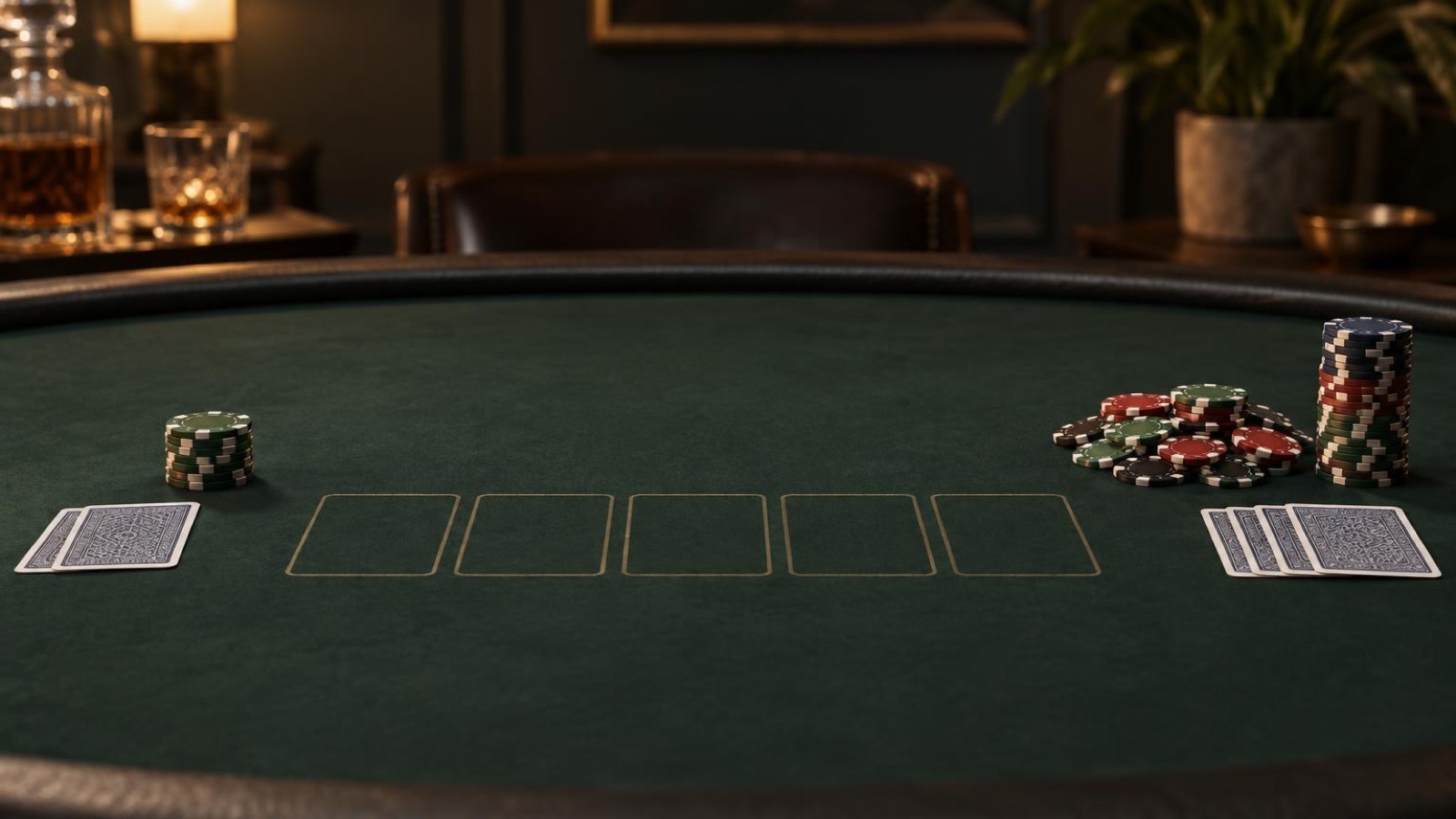
Omaha vs Texas Hold'em: the short answer
If you already know Texas Hold'em, you know most of Omaha. Both are community card games: everyone gets private cards, five shared cards land face up in the middle, and there is a round of betting before the flop, after the flop, after the turn and after the river. The best five-card hand wins the pot, and if players tie, they split it evenly2.
The difference that matters is in your hand. In Texas Hold'em you get two private cards and you can use none, one or both of them alongside the community cards to build your best five-card hand1. In Omaha you get four private cards, and you must use exactly two of them plus exactly three community cards. No more, no fewer2.
That single rule changes everything about how the games feel. Omaha is sometimes called Omaha Hold'em because the two are so closely related, but the four-card start makes strong hands far more common and turns the game into what players call a "nut" game: if you do not hold the best possible hand, your chances of winning the pot are extremely low2.
Both games use the same hand rankings, so a flush still beats a straight and a full house still beats a flush3. You do not need to learn a new ranking table to switch between them.
How the two games deal their hole cards
The deal is where the two games visibly part ways, and it happens before any community card appears.
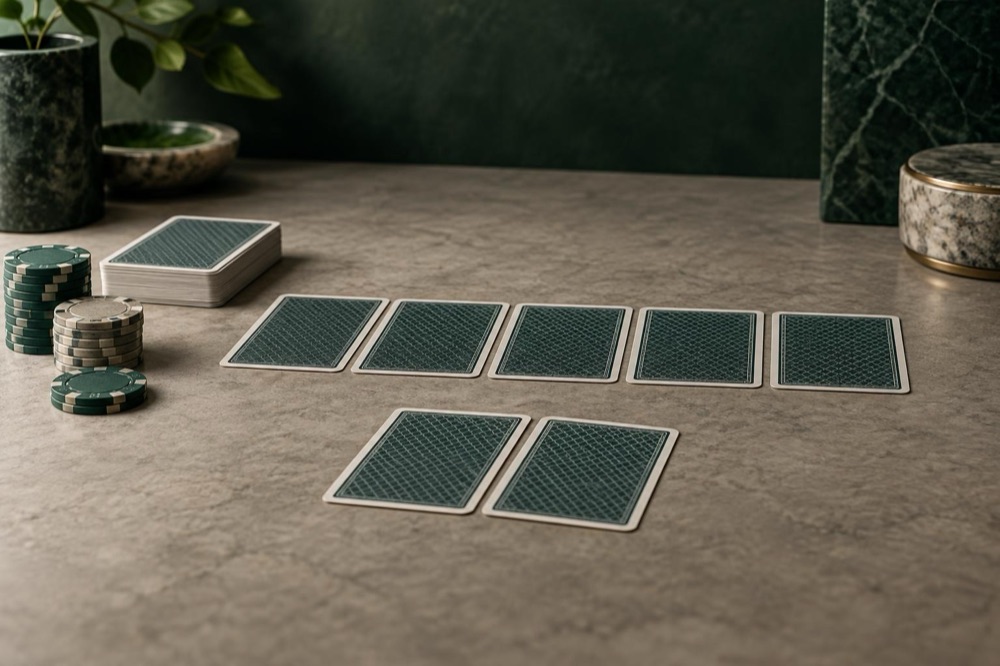
In Texas Hold'em, the dealer gives each player two cards face down, one at a time, starting from the small blind1. Those two cards are your whole private hand for the rest of the deal. The small blind posts a bet equal to half the minimum bet before cards are dealt1.
In Omaha, the dealer keeps going until everyone has four cards face down6. Same table, same blinds, same five community cards, but twice the private information in front of you.
From there the two games run in parallel:
- The flop: three community cards dealt face up in the center of the table1
- The turn: a fourth community card
- The river: a fifth and final community card
- The showdown: the best five-card hand takes the pot7
In Omaha, the player to the immediate left of the big blind, the third player after the button, acts first before the flop2. That is the same seat that acts first in Hold'em, so if you are used to tracking position in one game, the habit carries straight over.
There are also bigger versions. Five-Card Omaha deals five hole cards instead of four, and Six-Card Omaha deals six8. Both use the exact same rules otherwise, and you are still required to use exactly two cards from your starting hand9. So a six-card Omaha player holding a monster still has to throw four of those cards away when building the final hand.
Hand strength: why Omaha hands run bigger
Four hole cards instead of two means many more possible combinations, and more combinations means more made hands. Straights, flushes and full houses show up far more often in Omaha than in Hold'em, which is why Omaha is described as a game where you make stronger hands more easily than in normal poker10.
The practical consequence is that your big pairs are worth less. In Texas Hold'em, pocket aces are the strongest starting hand, and any hand can still win depending on how it is played11. In Omaha, the edge you have pre-flop with a pair of aces is a lot lower than it would be in Texas Hold'em4. A pair of aces against kings in Omaha is rarely more than a 55% favorite12. In Hold'em that same matchup is a much bigger favorite.
This is why Omaha regulars talk about drawing to the nuts rather than protecting a big pair. If you hold the second-best flush on the river in Omaha, you are usually beaten, because someone at the table was drawing to the same suit with better cards.
The best Omaha starting hands reflect this. The strongest holding is A-A-K-K double-suited, and the second best is A-A-J-T double-suited9. Other premium Omaha hands include AAKK, AAJ10, KKQJ, JJQK, 8876, 7789, AKQJ and KQJ103. Notice how many of them are four connected or double-suited cards rather than a simple pair. In Hold'em the best starting hands are AA, KK, QQ, JJ, AK, TT, AQ, AJ and KQ3.
Starting hands: what changes between the games
Texas Hold'em has 169 possible starting hand outcomes, and what happened in the previous hand does not affect the outcome of the current one1. That is a small, learnable universe. Most players can memorize a reasonable opening range in an afternoon.
Omaha does not work that way. With four cards, the number of distinct starting hands explodes, and the value of a hand depends heavily on how well the four cards work together. A hand like A-A-7-2 with no suits is far weaker than it looks, because the aces have no backup and the other two cards cannot make a straight or a flush.
Strong starting hands matter in Omaha, and you are choosing from four hole cards and five community cards rather than two and five13. The practical rules of thumb that experienced players use:
- Suited and connected beats big and disconnected. A-A-K-K double-suited is the best hand in the game; A-A-7-2 rainbow is a trap9
- You want all four cards working. Two cards that make a hand and two that do nothing is a Hold'em hand, not an Omaha hand
- Position matters more, not less. Acting last with four cards is a bigger advantage than acting last with two
- Fold more pre-flop than you think. The temptation to see a flop with any four cards is the most common Omaha leak
If you want the full breakdown of which four-card holdings are worth playing, the Omaha poker rules page covers PLO, PLO-5, PLO-6 and Omaha Hi-Lo in detail.
Betting structure and pot odds compared
The betting structures differ in a way that shapes how each game plays.

Texas Hold'em has no betting limit in its most common form, and Omaha is usually pot limit14. Omaha can be played with or without betting limits, but the standard version is pot-limit Omaha, abbreviated PLO2. In a pot-limit game, the largest bet you can make is governed by the pot size in front of you, and you can never bet an amount higher than the pot5.
That cap matters. In no-limit Hold'em, a player can shove their entire stack at any moment, which is why Hold'em produces dramatic all-in confrontations. In pot-limit Omaha, the maximum bet grows with the pot, so the betting escalates in steps rather than in one jump.
| Texas Hold'em | Omaha | |
|---|---|---|
| Hole cards | 2 | 4 |
| Community cards | 5 | 5 |
| Cards you must use | Any combination | Exactly 2 hole cards |
| Common betting structure | No-limit | Pot-limit (PLO) |
| Typical pot size | Smaller | Bigger |
Both games can be played in no-limit, pot-limit and fixed-limit formats, and online rooms commonly spread Texas Hold'em and Omaha side by side using all three structures15. In fixed-limit Hold'em, the first two betting rounds use the small blind amount and the last two rounds use the big blind amount6. Fixed-limit Hold'em is more commonly found in live poker rooms in the United States and is rarely played online5.
Pot odds work the same way in both games. What changes is how often you are actually ahead when you call. Because Omaha hands run bigger, a call that would be correct in Hold'em is often a losing call in Omaha, since your opponent is more likely to have the hand they are representing.
If you want to go deeper on how the three structures change strategy, the no-limit vs pot-limit vs fixed-limit page breaks it down.
Where the games are played in Asia
Both games are widely available across Asia, in casinos, in dedicated poker rooms and online.
Macau is the region's established poker market. Texas Hold'em was approved as a licensed casino game in 2008, and Omaha Poker followed in 2010, both operated by the city's casino concessionaires and sub-concessionaires6. Macau casinos are open 24 hours18. Poker rooms in the city have historically spread both games, and licensed poker operators in the region include dedicated poker rooms as well as casino floors19.
The Philippines runs a regulated poker market through PAGCOR, which licenses poker operators19. Cambodia has hosted poker series at venues such as the Las Vegas Sun Hotel & Casino in Svay Rieng21. Elsewhere in the region, poker clubs, bars and amusement venues spread games without cash prizes, which is a different category from casino poker.
Online, both games are available to players across Asia on international sites. Bovada Poker spreads Texas Hold'em, Omaha and Omaha Hi-Lo, using no-limit, pot-limit and fixed-limit betting structures15. Other operators spread Texas Hold'em cash games, tournaments and variants alongside Omaha14.
One practical note for visitors and expats: online poker availability and legality vary by country, and the rules that apply to you can differ depending on whether you are a citizen, a resident or a visitor. The poker for visitors and expats page covers entry, ID, currency and online account questions.
Poker's rise and retreat in Macau
Macau's poker scene has moved in both directions over the past two decades.
Texas Hold'em arrived as a licensed game in 2008, when the Secretary for Economy and Finance permitted casino concessionaires to operate it and approved the official rules6. Omaha Poker was approved two years later16. For a stretch, Macau was the center of Asian poker, with cash games and tournaments running across multiple properties.
That has narrowed. During 2025, four casinos stopped offering Texas Hold'em, leaving only the Venetian and MGM Cotai spreading the game20. The poker rooms that remain still run cash games and tournaments, but the days of every major Macau property having a poker room are over.
For a visitor planning a poker trip, the practical takeaway is simple: check which properties are currently spreading the game before you book, and do not assume every casino on the strip has a table. The poker in Asia pillar keeps a current view of card rooms and tournaments across the region.
Which game should a new player learn first
Learn Texas Hold'em first. It is the more forgiving game for a beginner, and it is the game you will find most often when you walk into a card room.
The reasons are practical rather than theoretical:
- Fewer decisions. Two hole cards means fewer combinations to evaluate on every street
- Smaller hand ranges to memorize. 169 starting hands is a manageable study list1
- Big pairs hold up. Pocket aces are genuinely the best hand in Hold'em, and the edge is real11
- More tables spread. Omaha is second in popularity only to Texas Hold'em, which means fewer games and often tougher lineups5
- The rules transfer. Once you know Hold'em, Omaha is a short step: same blinds, same five community cards, same hand rankings, one extra rule about which cards count2
The aim in Texas Hold'em is to either win at showdown with the best five-card hand or force your opponents to fold before the showdown5. That is a clean, learnable objective, and it teaches you the fundamentals of position, betting and reading opponents that you will need in Omaha anyway.
When you do move to Omaha, expect to lose money for a while. The hands that win in Hold'em are often second best in Omaha, and the players who beat you will be the ones who folded the pretty hands you could not let go of. Start at pot-limit tables with small blinds, play fewer hands than feels natural, and treat every big pair as a drawing hand rather than a made hand.
If you want to compare the two rule sets side by side before you sit down, the Texas Hold'em rules page walks through blinds, betting rounds and the flop, turn and river, and the poker hand rankings page covers the rankings both games share.
Common Questions
Is Omaha harder to learn than Texas Hold'em?
The rules are just as simple, but Omaha is harder to play well. You get four hole cards instead of two, so more hands look playable and it is easier to make a strong hand. A pair of aces has a much smaller pre-flop edge in Omaha than in Hold'em.
How many hole cards do you get in Omaha?
Four, dealt face down, compared with two in Texas Hold'em. Both games then deal five community cards face up in the middle of the table. Five-Card Omaha deals five hole cards and Six-Card Omaha deals six, but the rest of the rules stay the same.
Can you use all four hole cards in Omaha?
No. You must use exactly two of your four hole cards, combined with exactly three of the five community cards, to make your best five-card hand. Using one or three hole cards is not allowed, even if it would give you a better hand.
Why do Omaha hands run bigger than Hold'em hands?
Four hole cards instead of two means far more combinations, so straights, flushes and full houses turn up much more often. In Hold'em a pair of aces is a huge favorite; in Omaha, aces against kings is rarely more than a 55% favorite.
Is Texas Hold'em legal in Macau casinos?
Yes. Macau approved Texas Hold'em as a licensed casino game in 2008 and Omaha Poker in 2010, and both are offered by the city's casino operators. Casinos in Macau are open 24 hours, and you must be 21 to enter.
Which game has bigger pots, Omaha or Hold'em?
Omaha usually produces bigger pots because more players make strong hands and stay in. Most Omaha is played pot-limit, so the maximum bet is capped at the size of the pot, while Texas Hold'em is often played no-limit with no cap on bet size.
Sources21 sources
- Texas Hold'em Community Poker, PlaySmart
- Omaha Community Poker, PlaySmart
- Poker Hand Rankings, GGPoker
- Holdem Omaha Differences, CoinPoker
- How to Play Poker Games, partypoker
- Texas Hold'em Poker Rules, DICJ Macau, January 18, 2008
- How to Play Texas Holdem Poker, CoinPoker
- Omaha Poker, WPT Global
- How to Play Omaha Poker, Natural8
- Deuce Wilde, Wikipedia
- Texas Hold'em Guide, CoinPoker
- Omaha Poker, partypoker
- Texas Hold'em, CoinPoker, September 4, 2026
- Texas Hold'em, CoinPoker, September 4, 2026
- Bovada Poker, Bovada
- Omaha Poker Rules, DICJ Macau, July 29, 2010
- Despacho do Secretário para a Economia e Finanças, Boletim Oficial de Macau, August 9, 2010
- Gaming and Entertainment, Macao Government Tourism Office, October 27, 2021
- List of Poker Operators with Issued Gaming License, PAGCOR, May 7, 2026
- Texas Hold 'Em in Macau, Maven of Macau, 2025
- Asian Series Cambodia, Asgam, July 2012















