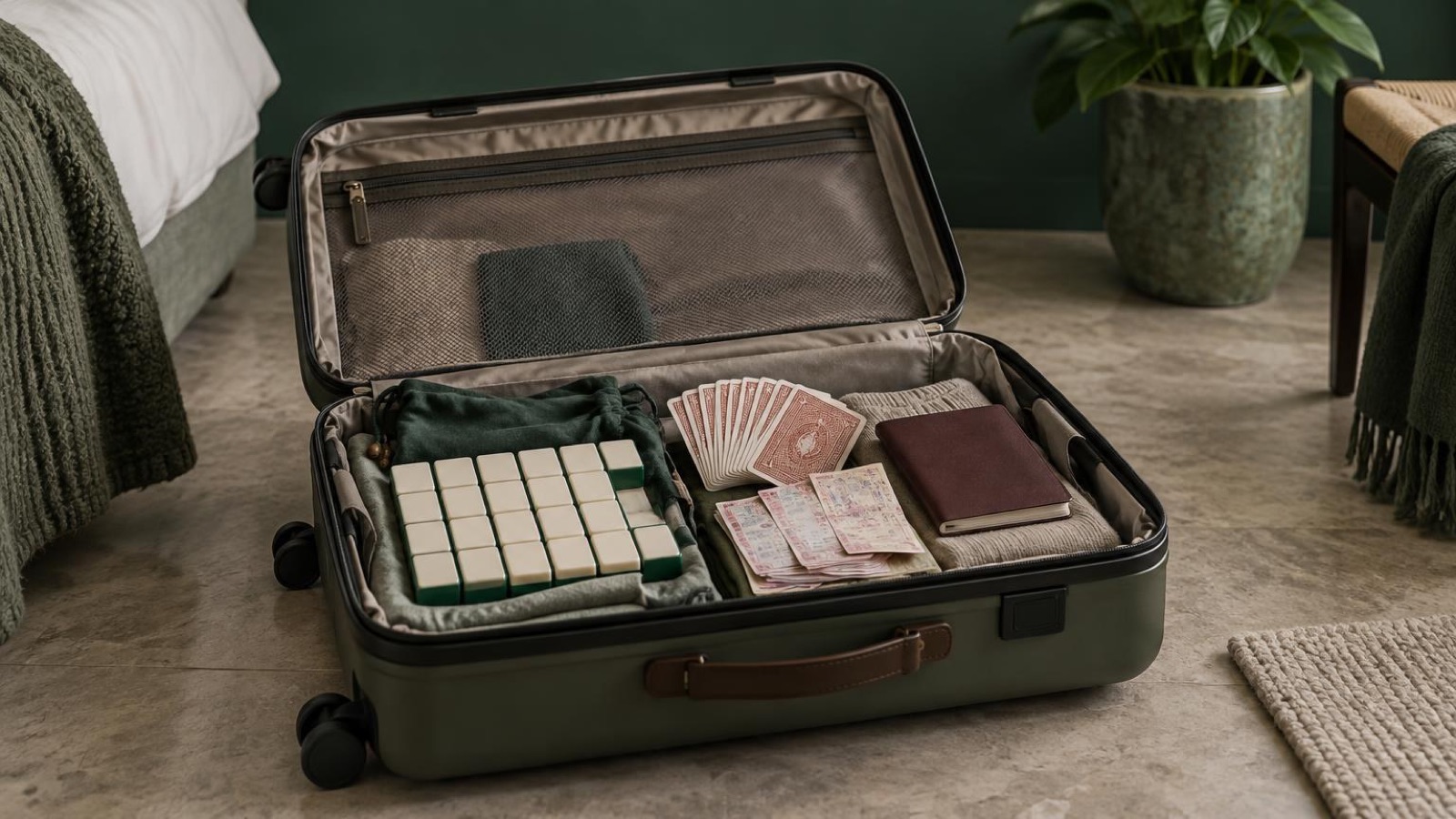
What counts as a gambling item at customs
Customs officers are not searching your bag for a deck of cards. They are looking for restricted goods, undeclared valuables and signs of commercial import. A gambling item becomes interesting to them when it looks like merchandise, when it is a casino's own token, or when the trip around it looks like cross-border gambling.
The practical split is simple. Playing cards, mahjong tiles, dice and paper lottery tickets are ordinary objects. You can buy them in any stationery shop, and carrying a set home is no different from carrying a board game. Casino chips and tokens are not ordinary objects. They are issued by a specific casino, they carry no value outside that property, and in some jurisdictions taking them out of the gaming floor is explicitly prohibited2.
The other thing customs watches is intent. In China, participating in cross-border gambling, whether inside or outside the border, is treated as a criminal and illegal act that public security organs crack down on5. That does not mean a pack of cards in your suitcase is a problem. It means a bag full of casino-branded chips, a stack of foreign betting slips and a story about a gambling trip can add up to questions you do not want.
If you are traveling for leisure and carrying a personal set of cards or tiles, you are in the ordinary-traveler lane. If you are carrying quantities that look like stock, or items that belong to a casino, expect to explain yourself.
Playing cards: allowed or not
Card games themselves are not the issue in most of Asia. What trips people up is where they play. In mainland China, mahjong and poker played for leisure, with no profit motive, in a chess and card room are lawful entertainment protected by law1. In Macau, players at a midi-baccarat table may squeeze or fold the cards, but crumpling or ripping them is not permitted2. If you are dealt a hand in a Macau football paper card game and a card is accidentally exposed during the deal, the exposed card stays valid and play continues3.

Where the answer changes is not the card but the use. In China, playing mahjong or poker in chess and card rooms for leisure, without a profit motive, is lawful entertainment protected by law1. The same guidance makes clear that using mahjong or poker as gambling tools in those rooms is illegal under the Public Security Administration Punishment Law, and in some cases criminal under the Criminal Law1. So the deck in your bag is fine. A deck in your bag plus a plan to run a game for money is not.
For visitors, the practical points are these:
- Bring a personal deck or two if you like. Nobody at the airport will ask about it.
- Do not bring large quantities of identical, sealed decks. That reads as commercial import and may attract duty or questions.
- Do not carry cards that are branded or packaged as casino equipment. Keep it plain.
- If you are heading to a casino, remember the casino supplies its own cards. You will not be allowed to play with your own deck at a table.
At the tables themselves, the house controls the cards. In poker, players typically receive two or five cards depending on the variation7. In Macau's football paper card game, players receive two to three cards and estimate the total points of the cards dealt to them or to other players, placing bets on the table layout8. If a card is accidentally exposed during the deal in that game, the exposed card remains valid and play continues8. None of this involves cards you brought from home.
Mahjong sets and tiles
A mahjong set is a box of tiles, and it travels as ordinary luggage. There is no customs category for it. Declare it only if your destination asks about the total value of goods you are carrying, the same as you would for any other gift or purchase.
What is worth knowing is what is actually in the box, because sets differ. A traditional set has 136 tiles: four each of the Dragons (中發白), four each of the four winds, and four each of 1 to 9 in bamboo, characters and dots, plus one dealer marker, three dice and a standard mahjong table9. A simple set has 112 tiles: four Green Dragon tiles, four each of 1 to 9 bamboo, four each of 1 to 9 characters and four each of 1 to 9 dots, plus one dealer marker, two dice and a standard table9. If you are buying a set abroad to bring home, check which version you are getting.
The rules of the game are not a customs matter, but they explain why the set is treated as harmless. In traditional mahjong, a hand is 14 tiles, four sets and one pair9. A player with three identical tiles may kong when the fourth is discarded, and after any kong the player draws one tile from the wall end and discards one to keep 13 tiles in hand9. In the simple version, the same kong rule applies but the player keeps five tiles in hand9. Discarded tiles may not be taken back, and a winner may win only up to the amount of money in hand9.
The line between a tile game and gambling is the money. Playing mahjong for leisure in a chess and card room is lawful in China; playing it as a gambling tool is not1. If you are carrying a set home as a gift, none of that applies to you. If you plan to play for stakes, know the local rule before you sit down.
Casino chips and tokens
This is the one category where the answer is usually no. Casino chips are the property of the casino, not of the player, and they are designed to circulate inside one property. Taking chips outside the casino gaming area is prohibited in Japan2. Even where there is no explicit rule, a chip from one casino cannot be used at another, and a chip in your luggage is a souvenir with no cash value.
The practical move is to cash out before you leave. At the cage, chips are exchanged back into currency. In Vietnam, Vietnamese players at licensed casinos may only use Vietnamese dong to exchange for gaming chips, and may exchange chips back into dong if the chips are unplayed or represent winnings10. Foreign players at prize-winning electronic game venues have more options: they may sell foreign currency to a licensed bank for dong, transfer the cash abroad through a licensed bank, carry it abroad with the bank's confirmation, or deposit it into their foreign currency payment account at a licensed bank12. Players can also authorize the venue to contact the licensed bank to handle deposits, transfers and applications for confirmation to carry foreign cash abroad12.
Payment methods inside casinos are also restricted in ways that matter if you are planning to bring money home. In Mauritius, no transaction may be carried out by credit card at a casino or gaming house13. Transactions happen at a main cash desk, and chips are handled at a live game table13. If you are used to paying by card, bring the cash you intend to use.
A few more practical points for chips:
- Chips are not currency. Do not declare them as cash, and do not expect a bank to exchange them.
- If you win, cash out at the cage and carry the currency, not the chips.
- Keep the receipt or cash-out slip. It is the only proof of where the money came from.
- If you are leaving a country with a large amount of local currency, check the cash declaration threshold before you fly.
Lottery tickets and betting slips
Paper lottery tickets travel fine. They are paper. The complication is claiming a prize, and that is where the rules bite.
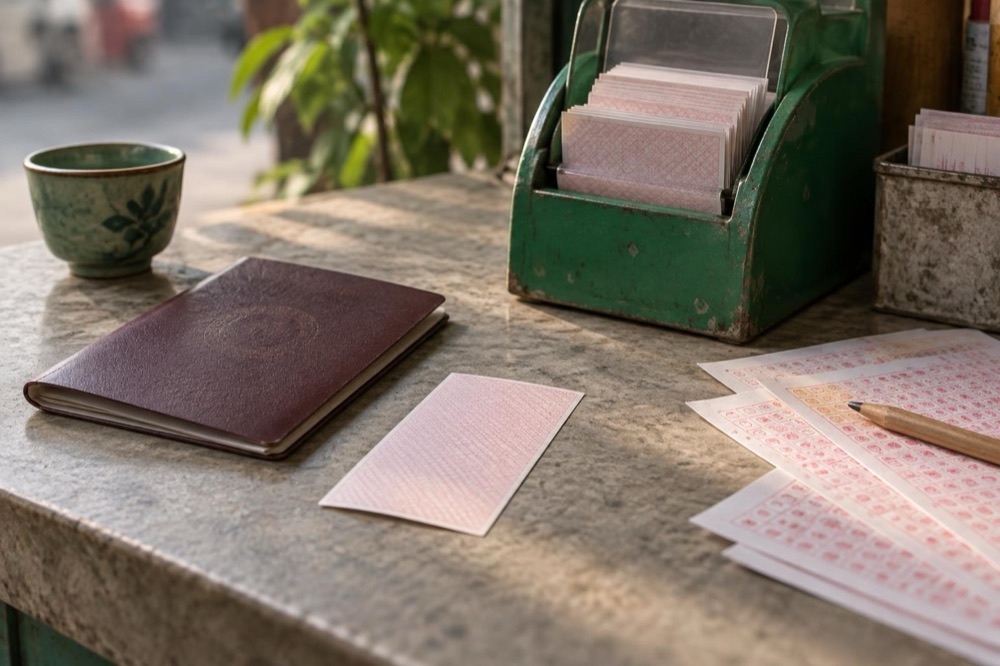
In Thailand, a foreign winner must present a passport or an official government-issued document together with the winning ticket3. In Japan, a sports lottery winner claiming at a shop needs the winning ticket and an identity verification document such as a driver's license or My Number card4. If you bought the ticket abroad and flew home, you may not be able to claim at all, because many lotteries require the claim to be made in the country of purchase.
Buying is a separate question from carrying. In Vietnam, selling lottery tickets is legal if it complies with the law, and selling tickets contrary to the law can bring administrative fines and criminal prosecution14. That is about the seller, not the traveler, but it tells you the trade is regulated.
If you buy lottery tickets online, the payment rules are stricter. In China, lottery purchasers using the internet must provide a bank debit card account in their own use and bind it to the betting account, and the personal information on the debit card and the betting account must match15. In Japan, Club toto membership requires a card whose charges are auto-debited from a bank account, because winnings are paid by automatic transfer; cards paid by salary deduction or convenience store collection cannot be used16. The maximum purchase amount per credit or debit card, and per official site reservation convenience store payment, is set separately by the Center17.
For Macau's sports lottery, bets may be accepted in patacas or Hong Kong dollars, but prizes and refunds are paid in the currency of the accepted bet18. If you bet in Hong Kong dollars, you are paid in Hong Kong dollars.
The practical checklist for tickets:
- Keep the physical ticket. A photo is not a claim.
- Carry the ID you used to buy it, or a passport if you are a foreign winner3.
- Check the claim deadline and the claim location before you leave the country.
- If you bought online, make sure the payment account is in your own name and matches your betting account15.
Duty-free limits and declarations
Gambling items are not duty-free goods in any special sense. They are personal effects, and they follow the same rules as anything else in your bag. The question is whether what you are carrying is personal or commercial, and whether it needs to be declared.
A single deck of cards, a mahjong set and a few paper tickets are personal. A suitcase of sealed decks, a crate of tiles or a folder of betting slips is not. If the value of what you are carrying is high, or if the quantity suggests resale, declare it and be ready to pay duty.
The declaration itself is straightforward. If a customs form asks whether you are carrying goods to declare, and you are carrying something that looks commercial, the answer is yes. Casino chips are not something to carry through customs, and they can be cashed out before you reach the airport.
The consequences of getting this wrong are not uniform, and they are not trivial. In China, participants in cross-border gambling face administrative penalties of detention and fines under the Public Security Administration Punishments Law, and criminal liability if a crime is constituted, besides possible large property losses6. That is the high end. For an ordinary traveler with a deck of cards, the realistic outcome is nothing at all.
A short table helps sort the categories:
| Item | Legal to carry? | Where it belongs | What to watch |
|---|---|---|---|
| Playing cards | Yes, personal use | Luggage | Large quantities look commercial1 |
| Mahjong set | Yes, personal use | Luggage | Value may need declaring9 |
| Casino chips | No, generally | Casino cage | Cash out before you leave2 |
| Lottery tickets | Yes, as paper | Luggage | Claim needs ID and may be in-country only3 |
| Betting slips | Yes, as paper | Luggage | Online accounts must match your own bank card15 |
If you are planning a casino trip and want to know how the entry rules differ for visitors, residents and citizens, the country guides cover that in detail. For the money side, see money for a casino trip. For crossing between Hong Kong, Macau and Zhuhai with gambling items in your bag, see getting between Hong Kong, Macau and Zhuhai. And if you are buying tickets as a visitor, lottery tickets for tourists explains who may buy and who may claim.
Common Questions
Can I bring playing cards through customs?
In most of Asia, yes. A deck or two of ordinary playing cards in your luggage is a personal item and is not what customs officers are looking for. The problem is not the cards themselves but what you plan to do with them, and in a few places the quantity or the intent can change the answer.
Do mahjong sets need to be declared?
A mahjong set is a box of tiles, not a controlled item, so it normally travels as ordinary luggage. Declare it only if your destination asks about the value of goods you are carrying. Playing mahjong for leisure is lawful in many places, but playing it for money is treated differently.
Are casino chips confiscated at the border?
Chips are the casino's own tokens, not currency, and they are meant to stay inside the gaming area. Taking chips out of a casino is prohibited in places like Japan, and chips from one casino are worthless at another. Cash out before you leave rather than carrying chips home.
Can I carry lottery tickets in my luggage?
Physical tickets are just paper and normally travel fine. The catch is claiming a prize: many lotteries require you to present the ticket with a passport or government ID, and some prizes must be claimed in the country where you bought the ticket. Check the claim rules before you fly.
What happens if I don't declare gambling items?
If the item is ordinary personal property, usually nothing. If you are carrying something that is restricted or you are suspected of cross-border gambling, the consequences are serious. In China, participating in cross-border gambling can bring detention, fines and criminal liability, so declare honestly and keep receipts.
Is there a limit on how many decks of cards I can bring?
There is no standard deck limit for personal travel in most of Asia. A single deck for a card game at home is unremarkable. Large quantities of identical decks, or cards packaged for resale, can look like commercial import and may attract duty or questions, so keep it small and personal.
Sources18 sources
- 棋牌室娱乐与赌博的法律界限, Beijing Municipal Bureau, 2020-06-29
- Enforcement Rules terms of use, JCRC Japan, 2021-07
- Lottery prize claim by foreigners, GLO Thailand, 2026-09-25
- Sports lottery winnings claim, Toto Dream Japan, 2026-09-25
- 公安机关打击跨境赌博犯罪, Ministry of Public Security, 2020-10-01
- Cross-border gambling penalties, Chifeng Public Security, 2026-01-12
- How to play poker, PlaySmart Canada, 2026-09-25
- Football Paper Card Statutory Rules, DICJ Macau, 2004-06-21
- Legal Mahjong Gaming Rules, DICJ Macau, 1991-08-05
- Decree 03/2017/ND-CP Article 12 clause 3, Thu Vien Phap Luat, 2023-11-09
- Higher casino entry fees proposed, Vietnam News, 2025-08-06
- Foreign currency prize payments, Bao Chinh Phu, 2022-07-18
- GRA Act 2007, Gambling Regulatory Authority Mauritius, 2007-09-10
- Lottery ticket selling rules, Thu Vien Phap Luat, 2025-07-30
- Lottery betting accounts, Ministry of Finance China, 2010-11-17
- Club toto membership, Toto Dream Japan, 2026-09-26
- Club toto membership terms, Toto Dream Japan, 2023-01-01
- Regulation of Sports Lotteries, Macau Official Gazette, 2018-04-20