What Kyo-ichi is
Kyo-ichi is a Japanese amusement parlor, the kind of place usually called a pachinko shop. The store covered here is the Yamashina branch, in the east of Kyoto. It is a walk-in venue: you turn up, you take a seat at a machine, and you play for as long as you like. There is no table gaming, no dealer, no card room and no sports book1.
That distinction matters if you are coming from a country where "casino" means something specific. Japan does not license casinos for general play. The country passed a law allowing integrated resorts with casinos, and the first of those is still being built, so for now the legal gambling you will actually find on a normal street in Kyoto is pachinko and pachislot, plus the state-run lottery and the four public racing sports. Kyo-ichi sits in the first of those categories.
The Yamashina store is built around machines rather than tables. The published figure is 150 slot machines, which puts it in the mid-sized range for a suburban parlor1. You will not find poker, baccarat, roulette or blackjack here, and you will not find a cashier handing out chips. What you will find is rows of machines, a lot of noise, and staff on the floor.
If you are looking for actual casino tables in the region, the nearest legal options are outside Japan. Macau is the obvious one, and there are several properties worth knowing about, including Galaxy Macau, City of Dreams Macau and Wynn Macau. South Korea has foreigner-only casinos such as Paradise City Casino near Incheon airport, and Singapore has two large integrated resorts, Marina Bay Sands Casino and Resorts World Sentosa Casino. None of those are in Japan, and none of them are what Kyo-ichi is.
Games and tables you will find
The short version: machines, not tables. The Yamashina store lists 150 slot machines1. In a Japanese parlor, that means pachislot machines, the local equivalent of a slot cabinet, alongside the pachinko machines that give the industry its name.
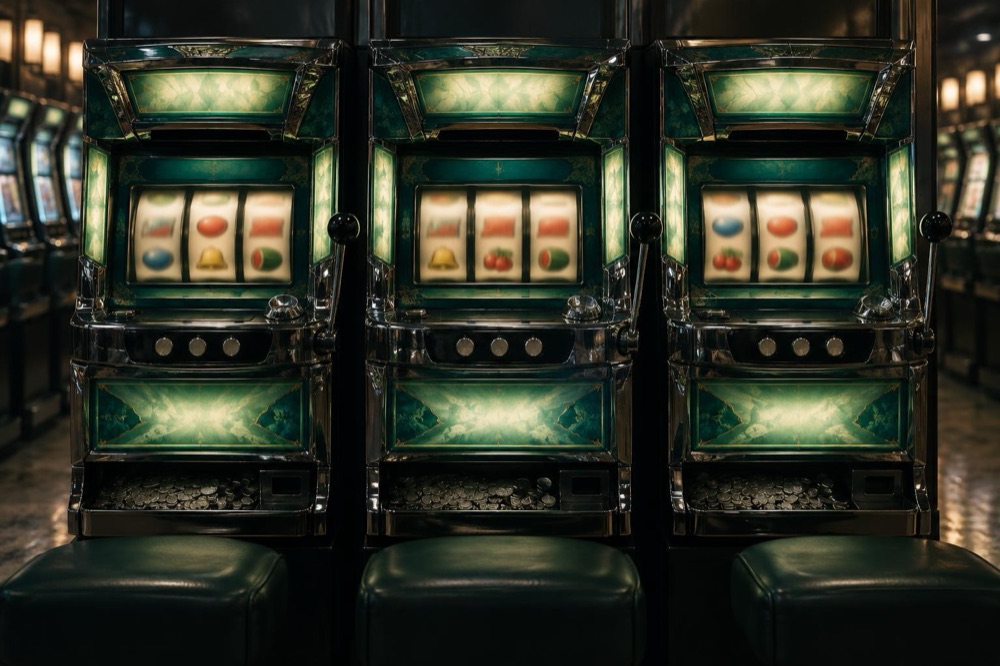
A quick word on how the play works, because it is not the same as a slot machine in Las Vegas or Macau. In a Japanese parlor you do not put coins in and collect coins out. You buy balls (for pachinko) or medals (for pachislot) at the counter or from a machine, you play them, and whatever you have left at the end is exchanged for prizes at the parlor's prize counter. Those prizes are then, in practice, taken to a separate exchange shop nearby. The parlor itself does not pay out cash at the machine, which is the structure that keeps the whole thing inside Japanese law.
That structure has practical consequences for you as a visitor:
- You cannot sit down with a banknote and expect a cash payout at the machine.
- You will need to work out the ball or medal purchase process, which is usually done at a counter or an automatic dispenser.
- The staff will help if you ask, but English support is not guaranteed at a suburban parlor.
- The minimum spend is small. You can play a few hundred yen and stop.
If your interest is in table games, sports betting or poker, Kyo-ichi is not the venue. For those, you would be looking at a trip to Macau, Singapore, the Philippines or South Korea. In the Philippines, for example, there is a long list of licensed operators, from Okada Manila and City of Dreams Manila to Solaire Resort Entertainment City and Newport World Resorts. In South Korea, Kangwon Land Casino at High1 Resort is the one property that admits Korean nationals, while the rest are foreigner-only.
Entry rules and who can enter
This is the simplest part of the page. Kyo-ichi is a walk-in parlor. There is no membership scheme, no advance booking, no guest list and no entry fee. You turn up during opening hours and you go in1.
There is also no published age gate at the door in the way a casino would have one. That said, Japanese parlors are adult venues in practice. If you look young, expect to be asked. Bring identification.
For foreign visitors, the practical points are these:
- You do not need a Japanese address, a Japanese phone number or a Japanese bank account to walk in and play.
- You do not need to show a passport at the door.
- Foreign visitors in Japan are expected to be able to produce identification if asked by police, so carrying your passport or residence card is sensible.
- There is no separate rule for tourists versus residents at a parlor like this. Everyone walks in the same way.
- Visitors aged 19 and younger must be accompanied by someone 20 or older2.
One thing worth knowing about the wider Japanese gambling landscape, because it explains why Kyo-ichi looks the way it does. The country's casino law, when integrated resorts eventually open, will restrict Japanese nationals to three visits in any seven-day period, and will ban organized crime members from casino floors entirely3. Parlors like Kyo-ichi are not covered by that regime. They operate under a different set of rules entirely, which is why there is no entry cap, no ID scan and no membership card.
If you want the fuller picture of what is and is not legal in the country, our guide to whether you can gamble in Japan covers the ground, and there is a separate page on who can go into Japanese casinos once the resorts open.
Membership and identification requirements
There are none for a normal visit. You do not register, you do not hand over a document, and you do not get a card. That is the whole answer for Kyo-ichi1.
It is worth contrasting that with the venues in Japan that do require registration, because the difference catches people out. At Tokyo City Keiba, for example, buying a reserved seat requires membership registration in advance5. The TCK Premium Card scheme requires an identity document issued by a public institution, such as a driver's license6. Club toto, the official sports betting site, requires membership registration before you can buy anything on it7, and the mail-in application route asks for original family register or resident record documents issued within three months, or a copy of a driver's license, passport, residence card, My Number card and similar8. Keirin's online services have their own registration screens with required fields9, and using points requires a separate point membership10.
None of that applies at Kyo-ichi. You are not opening an account, you are not placing a bet through a licensed operator, and you are not claiming a large prize from a state lottery. The identification rules that matter in Japan tend to attach to those things rather than to a walk-in parlor.
The one place ID genuinely matters in Japanese gambling is prize claims. If you win more than JPY 500,000 on a single lottery ticket, you need photo ID to claim it, and above JPY 1,000,000 you need photo ID plus a personal seal, with the ticket submitted at a Mizuho Bank and payment taking about a week11. That is the lottery, not a parlor, but it is the kind of rule that surprises people, so it is worth knowing.
How to get there
The Yamashina store is at 191-2 Nagatsujihirata-cho, Yamashina-ku, Kyoto City, Kyoto Prefecture1. Yamashina is a district in the east of Kyoto, on the other side of the Higashiyama hills from the main tourist core around Gion and Kawaramachi.
Yamashina is well connected. It is served by JR West, and the Kyoto subway Tozai Line runs into the district. From central Kyoto, the trip is short. From Kyoto Station, you are looking at a few stops on the JR lines that run east. From the Kawaramachi and Gion area, the subway Tozai Line is usually the simplest route.
A few practical notes for getting there:
- The store is in a residential and commercial district rather than a tourist area, so signage is in Japanese.
- If you are navigating by map app, paste the address rather than the name, since the name alone may not resolve cleanly in English.
- Taxis in Kyoto are plentiful and will take the address without trouble.
- If you are coming from Osaka, the JR Kyoto Line and the Hankyu and Keihan lines all run between the two cities, and Yamashina is a straightforward connection from Kyoto Station.
For comparison, other Japanese gambling venues are spread across the country. The public racing tracks are listed below.
| Track | Address |
|---|---|
| Kochi Keirin Track | 45 Ohara-cho, Kochi, Kochi2 |
| Hiroshima Keirin Track | 3-6-40 Ujina Kaigan, Minami-ku, Hiroshima2 |
| Komatsushima Keirin Track | 5-57 Yokosu-cho, Komatsushima, Tokushima2 |
Those are all a long way from Kyoto. If you are in Kansai and want a racing day out, the J-PLACE satellite betting offices at Nagoya and Yatomi open their gates at 9:0012.
Opening hours and what to expect on arrival
Kyo-ichi's Yamashina store opens at 10:00 and closes at 23:001. That is a 13-hour day, which is normal for the industry. You can drop in mid-morning when it is quiet, in the early evening when it is busiest, or late at night when it thins out again.
What to expect when you walk in:
- Noise. Japanese parlors are loud, with music, machine sound effects and announcements running continuously.
- Smoke. Many parlors still allow smoking on the floor, and ventilation varies.
- Rows of machines, usually grouped by type, with aisles between them.
- A prize counter, where you exchange what you have left for prizes.
- Staff on the floor in uniform, who can point you to a free machine or the purchase counter.
There is no formal arrival process. You do not check in, you do not show a card, and you do not get a wristband. You find a machine that is free, you sit down, and you start. If you need to buy balls or medals, the counter or an automatic dispenser will handle it.
A few things to bring or plan for:
- Cash. Parlors are cash-based, and while some machines take notes directly, having coins and small notes makes life easier.
- Your passport or residence card, for the general reason that foreign visitors in Japan are expected to carry identification.
- A willingness to ask for help in simple terms. Staff at a suburban parlor may not speak English, but pointing works.
- Time. A session can be 20 minutes or three hours, depending on you.
If you are comparing this with a proper casino visit elsewhere in Asia, the experience is different in kind. A casino has a cage, a dress code, an age check at the door and table minimums. Kyo-ichi has none of those. It is closer to an arcade than to a gaming floor, and that is the honest way to think about it.
For anyone planning a first casino trip in the region, the pages on NagaWorld in Cambodia, Resorts World Genting in Malaysia and Hoiana Resort & Golf in Vietnam give a sense of what a licensed Asian casino actually involves. And if you are waiting for Japan's own resorts, our page on when the Osaka casino resort will open tracks that.
Common Questions
What is Kyo-ichi?
Kyo-ichi is a Japanese pachinko and slot parlor, with a store in Yamashina-ku in Kyoto. It is a walk-in amusement venue rather than a casino, so there is no membership, no entry fee and no table gaming. The Yamashina store runs 150 slot machines.
Where is Kyo-ichi located?
The Yamashina store is at 191-2 Nagatsujihirata-cho, Yamashina-ku, Kyoto City, Kyoto Prefecture. That is in the east of the city, in the Yamashina district. The store is the one covered on this page.
Do I need ID to enter Kyo-ichi?
No. There is no membership scheme and no ID check at the door for a normal visit. Bring photo identification anyway if you plan to be in Japan as a visitor, since you are expected to carry your passport or residence card with you.
What games does Kyo-ichi offer?
The Yamashina store has 150 slot machines. Japanese parlors of this kind are built around pachinko and pachislot machines, which are played for balls or tokens that are exchanged for prizes, not for direct cash payouts at the machine.
How do I get to Kyo-ichi?
The store sits in Yamashina-ku, Kyoto, at 191-2 Nagatsujihirata-cho. Yamashina is served by JR West and by the Kyoto subway Tozai Line, and the store is a short walk from the local station area. Check the route before you set out.
What are Kyo-ichi's opening hours?
The Yamashina store opens at 10:00 and closes at 23:00. That is a long day by any standard, so you can drop in mid-morning, after work or late in the evening. Hours can change on holidays, so it is worth a quick check.
Is there a dress code at Kyo-ichi?
No. There is no published dress code for the store. Japanese pachinko parlors are casual places and people come as they are. The only practical point is that the halls are loud and smoky in places, so dress for a busy indoor space.
Sources12 sources
- KYO-ICHI Yamashina Store, Matsubara Kosan, 2026
- Keirin and auto race events in Chushikoku, Keirin Auto Race, 2026
- Petition on integrated resort entry rules, House of Councillors, 2026
- Integrated resort policy document, Japan Tourism Agency, 2026
- Tokyo City Keiba reserved seat buying guide, Tokyo City Keiba, 2026
- TCK Premium Card, Tokyo City Keiba, 2026
- Club toto, Club toto, 2026
- Club toto membership guide, Club toto, 2026
- Keirin Net Bank Service registration, Keirin, 2026
- KEIRIN Official Point, Keirin, 2026
- Takarakuji for inbound visitors, Takarakuji Official, 2026
- J-PLACE information, Nagoya Keiba, 2026