

The difference in one table
| Social casino app | Real online casino | |
|---|---|---|
| Cost to download | Free | Free |
| What you buy | Virtual chips, no cash value | Real-money balance |
| Can you withdraw winnings? | No | Yes, where licensed |
| Payouts | None | Real |
| License required | No | Yes |
| Legal to play from Japan | Yes | No, and players have been prosecuted2 |
The table is the whole category in five lines. A social casino looks like a casino, sounds like a casino, and is legally not one, because nothing comes back out.
Where social casino games are available
Social casino games are everywhere you have a phone. They sit in the same app stores as ordinary puzzle games, they are free to download, and they do not ask for a casino license because they do not pay out real money. That is the whole trick of the category.
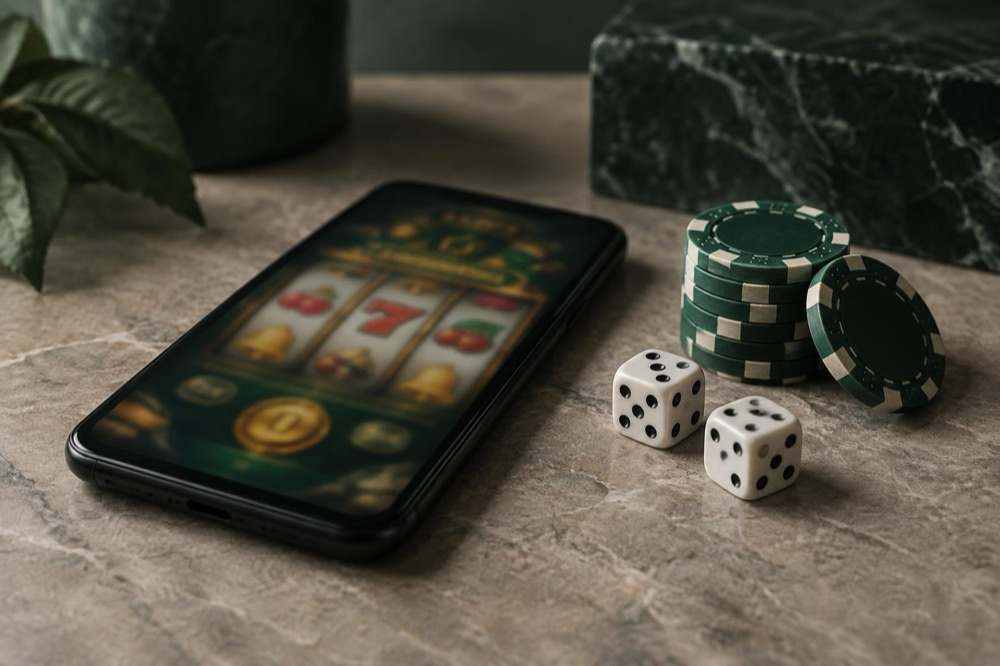
The games themselves mimic the real thing closely. Slot simulators spin reels with the same symbols and sound effects. Virtual poker apps deal the same hands. Bingo and roulette apps copy the layouts. Some are standalone apps; others are mini-games tucked inside larger platforms, where you might spin a wheel for a bonus or open a loot box for a cosmetic item. The mechanics are borrowed wholesale from regulated casino floors, where permitted games include baccarat, blackjack, craps, sic bo, roulette, pai gow and poker4.
That borrowing is not accidental. The visual and audio design of a social casino is meant to trigger the same anticipation a real machine does, and the near miss (two matching symbols and a third just off) is a standard feature. Researchers treat this as simulated gambling: the behavior is the same, only the payout is missing.
Where you are matters for what is legal around you. In Macau, casino floors run a fixed list of permitted games under the local gaming law4. In the Philippines, poker rooms operate under issued gaming licenses5. In Hong Kong, amusement game centers are licensed separately, and if illegal gambling is found on the premises, the customers taking part are also considered to have broken the law6. None of that touches a free slot app on your phone, but it explains why the line between game and gambling is drawn where it is.
Free to play, but not free to keep playing
The phrase free to play is doing a lot of work. You can download a social casino app at no cost and play for a while on the chips it gives you. Then the chips run out, and the app offers more. That is the business model.
Virtual coin packages are sold for real money, in tiers that start small and climb. You are buying chips that have no cash value, cannot be withdrawn, and cannot be exchanged for anything outside the game. There is no jackpot, no payout, no way to win money back. What you are paying for is the experience of playing, and the experience is engineered to make you want more of it.
Loot boxes work the same way. You pay for a box, you open it, and you get a random item. The item might be cosmetic, might be useful, might be one you already have. The randomness is the point: it produces the same variable-reward pattern that slot machines use, and that pattern is what makes both hard to walk away from.
This is where the harm question starts. A player who spends real money on virtual chips has lost that money in real terms, even though nothing was ever won. The spending can escalate quietly, because each purchase is small and each one feels like the last. By the time the total is visible on a bank statement, the habit is established.
If you want to see where your own play sits, Singapore's National Council on Problem Gambling publishes a self-test you can take online, and the same page explains when gambling becomes a problem1. It is free, it takes a few minutes, and it does not commit you to anything.
What the research does and does not show
The honest answer is that the research is still developing, and anyone who tells you it is settled is overselling. What the evidence does show is a consistent association: people who play social casino games and open loot boxes are more likely to gamble with real money later, and more likely to show problem gambling symptoms. What it does not show is that every player will develop a problem. Most will not.
The pattern that worries researchers most is the age at which this starts. Loot boxes and social casino apps are played heavily by teenagers, and the mechanics they learn there (chasing a near miss, buying one more box, playing past the point of enjoyment) transfer directly to real gambling products. A young person who has spent two years opening loot boxes arrives at a real casino or a real betting app already fluent in the language.
There is also a straightforward substitution effect. Social casino apps are often marketed as a safe alternative to real gambling, and for some players they may be exactly that. For others, they function as a warm-up: the appetite is fed without the risk, and then the risk gets added. The same app can do both things for different people, which is why the research cannot give a clean yes or no.
What is not in dispute is the direction of the link. Health bodies and regulators across the region treat simulated gambling as a risk factor worth monitoring, which is why responsible gambling programs now include patron education and help services alongside the games themselves7. The point is not to ban the apps. It is to know what you are doing when you open one.
If you want to understand how problem gambling is defined clinically, and where the line sits between a habit and a disorder, there is a plain explanation in what gambling disorder is. For the warning signs to watch for in yourself, see signs of a gambling problem.
Getting help: NCPG counseling appointments
Singapore's National Council on Problem Gambling runs the most accessible support in the region for anyone worried about their play, whether it is real gambling or the simulated kind. The services include counseling, self-exclusion and visit limits, family exclusions, third-party exclusions, and exclusions by law3.
The first step is usually a Harm Assessment or a counseling appointment. You book those by calling the NCPG hotline at 6354 81541. The same number handles questions about exclusion and visit limit status8. There is also a general problem gambling helpline at 1800-6-668-668, which is the number printed on Singapore Pools materials and promoted as the place to call if gambling is affecting you9.
Other online services are unaffected. You can still check your exclusion status and your visit limit status through NCPG e-Services, apply for a voluntary visit limit online, and apply for a family exclusion order online3.
If you are not in Singapore, the same category of help exists across the region:
- Japan: the Public Sports Gambling Addiction Counseling Center offers phone counseling, a self-check tool and email counseling13.
- Hong Kong: the Hong Kong Jockey Club's responsible gambling pages list a Problem Gambling Counselling and Treatment Centre at 6829 876414.
- Philippines: the regulator has ordered gambling advertising to carry problem gambling helpline materials, and its National Problem Gambling Helpline serves as a 24/7 support platform15.
For a fuller picture of what is available where you are, including numbers, hours and languages, see gambling help lines in Asia. If you are a visitor, an expat or an international student, gambling help for expats and visitors covers how to access support when you are not a citizen. And if cost is the worry, gambling addiction treatment explains what counseling and therapy typically involve.
RGC BetGuard campus tour: prevention among students
The Responsible Gambling Council, which works on prevention across regulated markets, runs patron education and help services, including assistance to patrons who seek help on responsible gambling matters or show signs of problem gambling16. Its 2026-27 Post-Secondary Campus Tour features BetGuard, Ontario's centralized self-exclusion tool for regulated online gambling, as the centerpiece16.
The logic of putting this on campuses is straightforward. Students are the group most likely to be playing social casino games and opening loot boxes, and the group least likely to have encountered a real self-exclusion scheme. A campus tour puts the tool in front of them before the problem starts, rather than after.
Self-exclusion is the practical version of I want to stop. You register, your name goes on a list, and licensed operators in that jurisdiction are required to refuse you service. It is not a cure and it does not cover unlicensed offshore sites, but it removes the friction-free option. If you want to understand how these schemes work and how long they last, how to self-exclude from gambling in Asia compares the main ones, and what happens after you self-exclude covers accounts, balances and marketing.
For students specifically, the risk profile is different from a middle-aged casino regular. The spending is smaller, the play is more likely to be on a phone, and the harm often shows up as debt, missed classes and mood changes rather than a dramatic loss. Young people and gambling goes through the warning signs and how to talk to someone about them.
If you are a parent or a partner watching someone disappear into a slot app, signs a family member has a gambling problem and help for families of problem gamblers are the places to start. And if the spending has already turned into debt, gambling and debt help covers credit and debt counseling.
One last practical point. Playing real online casinos from Japan is illegal, and players have been prosecuted, even when the operator is legally run overseas2. Cross-border gambling can also bring detention, fines and, in some cases, criminal liability, on top of the money lost18. Social casino apps are not that, but the gap between the two is narrower than the app store makes it look.
Common Questions
Are social casino games the same as online casinos?
No. Social casino games are free-to-play apps that use virtual chips with no cash payouts. Real online casinos take real money and pay real winnings. But the two look and feel almost identical, and that similarity is part of why researchers worry about them.
Do you have to pay to play social casino games?
Downloading is usually free, but most social casino apps sell virtual coin packages for real money. You can spend hundreds of dollars on chips that have no cash value and cannot be withdrawn. That is the core difference from a real casino.
What are examples of social casino games?
Common examples include slot-machine simulators, virtual poker and bingo apps, and casino-style games inside larger platforms. They mimic real casino games like slots, poker and roulette but pay out only in virtual currency.
Can you play social casino games on your phone?
Yes. Almost all social casino games are built for phones and tablets, available through the Apple App Store and Google Play. They are designed for short, frequent sessions, which is one reason they can become habit-forming.
Is NCPG online appointment booking currently available?
No. Online booking for Harm Assessment and Counselling appointments in Singapore is unavailable from September 11, 2026 to October 10, 2026. During that period you book by calling the NCPG hotline at 6354 8154 instead.
What is the RGC BetGuard campus tour?
It is a 2026-27 post-secondary campus tour run by the Responsible Gambling Council that will reach up to 10,000 students. It presents BetGuard, Ontario's centralized self-exclusion tool for regulated online gambling, as a prevention measure for students.
Sources18 sources
- Do you have a gambling problem? Do a self-test, MSF/NCPG, 2026
- オンラインカジノは犯罪です, National Police Agency, 2026
- Other support services, NCPG, 2026
- Law 16/2001, permitted games of fortune, Government of Macao, 2015
- List of Poker Operators with Issued Gaming License, PAGCOR, 2026
- Amusement game centres and the Gambling Ordinance, Government of Hong Kong, 2008
- Harm minimisation, Gambling Regulatory Authority of Singapore, 2026
- Check exclusion and visit limit status, MSF/NCPG, 2026
- Step-by-step guide to self-exclusion, NCPG, 2026
- 4D lottery homepage, Singapore Pools, 2026
- Exclusion orders and visit limits by NCPG and others, GRA, 2026
- Revoke or vary a third party exclusion order or visit limit, MSF/NCPG, 2026
- Dependence support, Nagoya Keiba, 2026
- Problem gambling help, Hong Kong Jockey Club, 2026
- PAGCOR orders replacement of gambling ads with problem gambling helpline materials, PAGCOR, 2026
- RGC announces 2026-27 Post-Secondary Campus Tour featuring BetGuard, Responsible Gambling Council, 2026
- オンラインカジノに関する注意喚起, National Police Agency, 2026
- 跨境赌博的法律后果, Chifeng Public Security Bureau, 2026















