Jueteng: an illegal numbers game
Jueteng is a numbers game that has been part of everyday life in the Philippines for well over a century, especially in Luzon. It is a street game: bets are taken by collectors who move through neighborhoods, and draws happen quietly, several times a day, rather than in any official venue1.
The game itself is simple. You pick two numbers, hand over your bet, and wait for the draw. Because a play costs as little as one peso, jueteng has always drawn its players from ordinary folk: market vendors, drivers, housewives, low-wage workers2. A 2006 New York Times report described the routine plainly: pick two numbers from the range, place the bet, and do it three times a day5.
The catch is that jueteng is illegal. It operates outside the government system, and betting on illegal gambling is treated as a criminal act for the bettor, not just the operator, according to PAGCOR6. The practical risk for a player is small in most places and most eras, but the game has no oversight, no receipts and no guarantee you will be paid. That is worth knowing before you hand money to a collector.
The game's reach is remarkable. A 2013 Philippine Star column described jueteng as "in full swing" despite decades of crackdowns, and noted that STL operators were all over Luzon as well, with the legal game and the illegal one often running side by side7. Sun Star reporting from 2015 likewise referred to the illegal numbers game jueteng in Luzon as a continuing story8.
How the game works: two numbers from 1 to 37
The mechanics are the same everywhere. The bettor, called the taya, chooses two numbers between 1 and 371. Esquire magazine describes it the same way: an illegal numbers game played by selecting two numbers ranging from 1 to 372. Inquirer's explainer on STL puts it simply: bets involve a pair of numbers from 1 to 373.
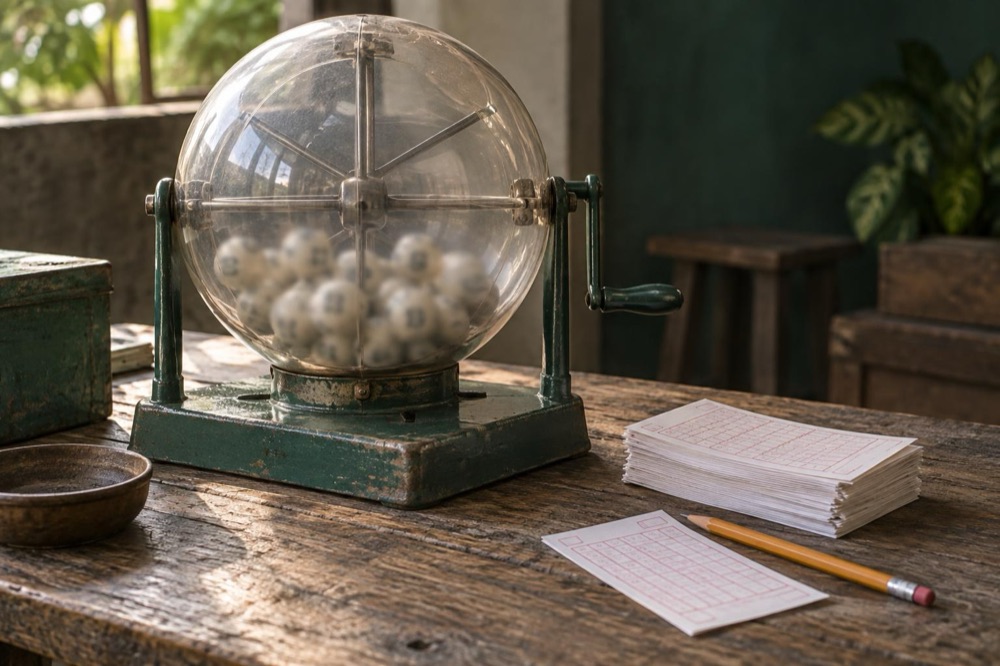
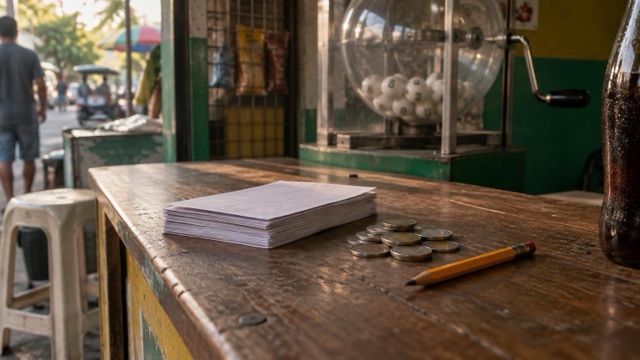
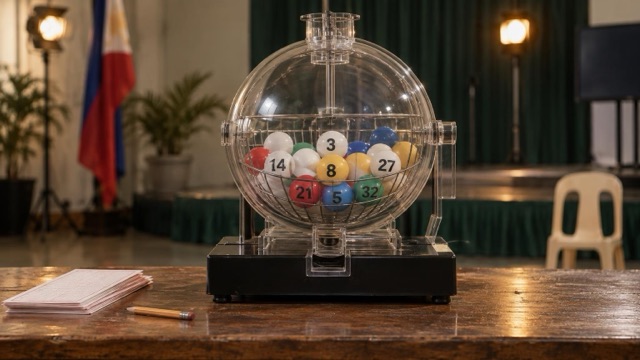
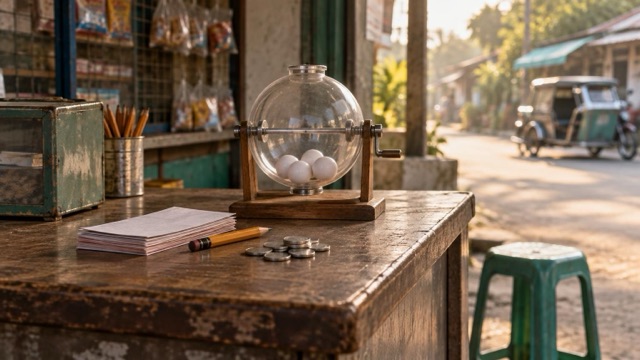
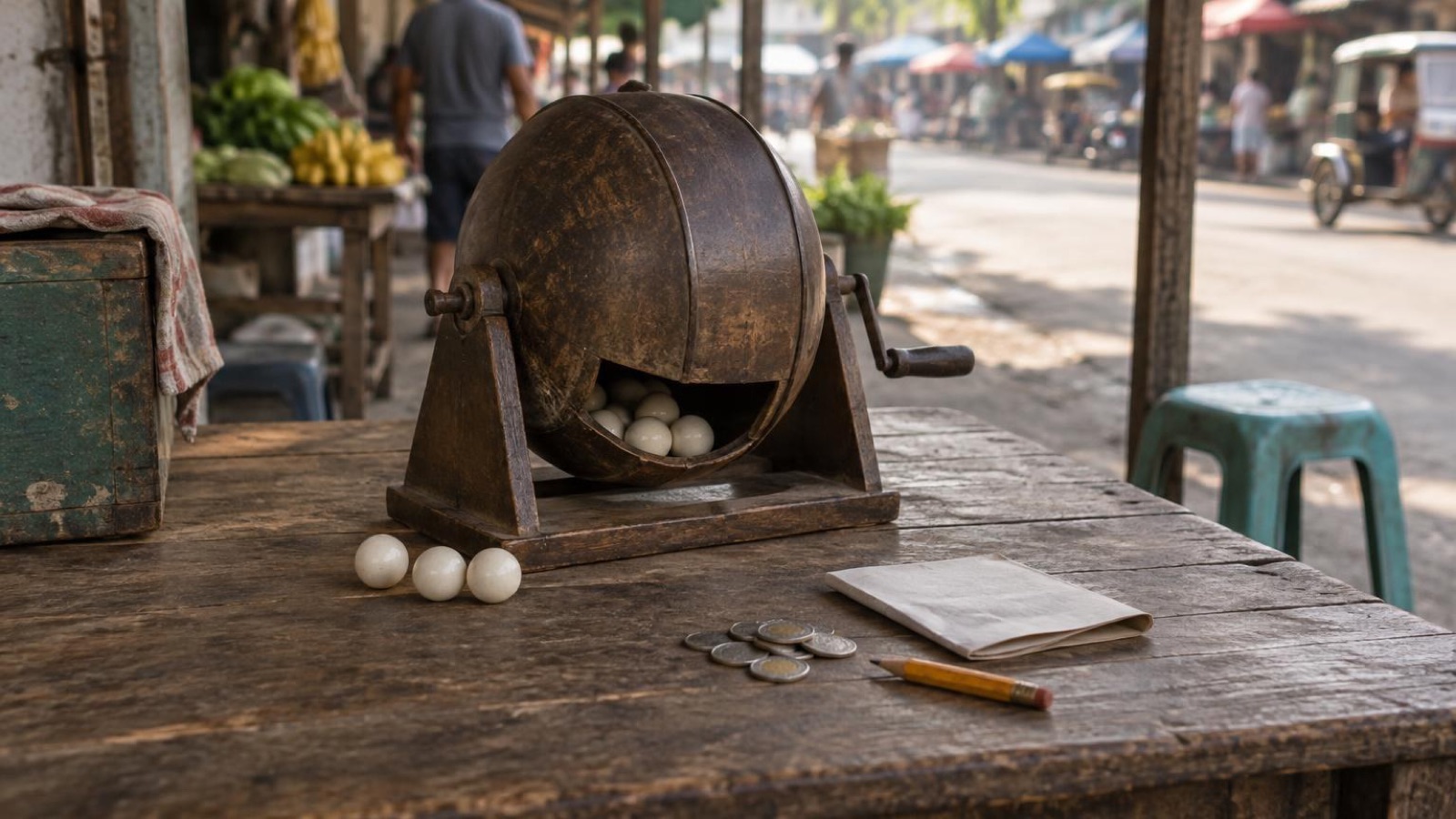
The draw is done with a tambiolo, a lottery drum, used together with 37 bolas, or balls, that are mixed to produce the winning numbers9. Two balls come out, and that pair is the winning combination for that draw. Only one combination wins in each draw, as a Manila Bulletin retrospective on the game's history noted10.
There is no skill involved and no strategy to apply. You cannot study past draws to improve your chances, because each draw is independent. The game's appeal is its simplicity and its price: anyone with a peso can play, and the result is known within hours.
Bets, draws and payouts
The entry cost is the game's defining feature. Bets can be as low as 25 centavos, though one peso is the figure most often cited2. Early-era reporting put the range at 25 centavos to one peso11. Ticket buyers historically paid ₱2 to ₱5 and up, knowing that only one combination would win10.
Draws happen frequently. It is typical for three games to take place each day: one in the morning, one in the afternoon and one in the evening1. The New York Times account of a collector's day described the same rhythm: place the bets, then return a few hours later to pay winners5.
The payout is where jueteng differs from most legal lotteries. Every ₱1 bet placed on the winning combination usually yields ₱700 to ₱900 in prize money1. Other accounts give a wider range: a bet of only ₱1 can win between ₱400 and ₱1,000, with the payout often depending on the number of entries9. Reporting from the game's early days gave the same ₱400 to ₱1,000 range11.
Here is what the numbers look like at the table:
| Your bet | Typical payout | Wider reported range |
|---|---|---|
| ₱1 | ₱700 to ₱900 | ₱400 to ₱1,000 |
| ₱5 | ₱3,500 to ₱4,500 | ₱2,000 to ₱5,000 |
| ₱10 | ₱7,000 to ₱9,000 | ₱4,000 to ₱10,000 |
That variability matters. Unlike a government lottery with fixed prize tiers, jueteng payouts float with the pool: the more people betting, and the more money collected, the more the winning combination pays. It also means the operator decides, and there is no regulator to appeal to if a payout falls short.
Where and how people place bets
There are no jueteng shops or counters. The game runs on a network of collectors, often called kubradores, who gather wagers as small as one peso and return a few hours later to pay winners5. The GMA News special report on the life of a kubrador, the collector at the center of the film "Kubrador," describes the daily round: walking the neighborhood, taking bets from regulars, recording them by hand, and settling up after each draw1.
This personal structure is why the game survives. The collector is usually a neighbor, someone known in the barangay, and bets are taken on trust. It also means the game is invisible to anyone not part of it: there is no storefront, no ticket, no receipt in most cases.
For a visitor or newcomer, there is no legitimate way in. The game is illegal, and betting on illegal gambling activities is itself a criminal act under Philippine law as PAGCOR states it6. The practical reality is that jueteng is a game for locals embedded in local networks, not something a tourist encounters or participates in.
Odds and what the game does not guarantee
The probability of guessing the winning combination in jueteng is 1 out of 1,369, since there are 37 numbers and the pair must match exactly1. Only one combination wins per draw, regardless of how many people are playing10.
It helps to put that in context. A 1-in-1,369 chance is far better than the odds of hitting a lotto jackpot, which is part of the game's appeal. But the payout of ₱700 to ₱900 on a peso bet is not proportionate to the risk: a fair game paying 1,369 to 1 would return ₱1,369 on a winning peso. The gap between the true odds and the payout is the operator's margin, and it is large.
Two things the game does not guarantee are worth stating plainly:
- Payment. There is no regulator, no receipt and no recourse if a collector or operator fails to pay.
- Fairness. The draw is conducted privately, and the game's long history includes repeated allegations of rigged draws.
The odds of winning never change from draw to draw, and playing more does not improve them; added up over time, players lose more than they win12. Chasing losses with bigger bets is not a winning approach in any game of pure chance.
Small Town Lottery: the legal counterpart and its suspension
Small Town Lottery, or STL, was created as the government's answer to jueteng: a legal, regulated numbers game that would offer the same low-stakes daily betting under official supervision. The Philippine Charity Sweepstakes Office (PCSO) runs it alongside its other products, and by 2017 the PCSO described STL as newly expanded13. The game closely mirrors jueteng, though it later increased the number bettors choose from 37 to 409.

STL draws are done locally, unlike the televised nationwide draws of PCSO lotto games3. An example of how local the operation is: the PCSO newsletter from June 2017 records an STL draw court at Unit 20, Ground Floor, Park and Shop Inc. Commercial Center, Dr. A. Santos Ave., Sucat, Parañaque City13.
Side by side, the two games look like this:
| Jueteng | STL | |
|---|---|---|
| Numbers to choose from | 1 to 37 | 1 to 40 |
| Draws | Local, up to three a day | Local draws, not televised |
| Minimum bet | 25 centavos to ₱1 | Small stakes through official outlets |
| Oversight | None | PCSO |
| Status | Illegal | Legal, but repeatedly suspended |
The game's history has been turbulent. STL was suspended in 1990, after which a House of Representatives investigation found that STL franchises were being misused9. In July 2019, President Duterte suspended all PCSO games, including lotto, STL, Keno and Peryahan ng Bayan, pending an investigation of irregularities14. Lotto draws resumed within days when the suspension was lifted, but STL, Keno and Peryahan ng Bayan remained suspended15. Reporting at the time noted the probe would focus on corruption in the agency16.
The suspensions had a human cost and an ironic one: jobless STL collectors told the Inquirer they were considering returning to jueteng, the very game STL was meant to replace17. During the COVID-19 pandemic, STL was suspended again in Luzon along with other PCSO lottery games18, while operations in the Visayas and Mindanao were monitored daily20. By August 2020, small town lottery operations remained suspended until further notice21.
Because STL's status has changed repeatedly, anyone wanting to play should check current PCSO announcements. When it runs, it is the legal way to play the same basic game jueteng offers.
For prizes, PCSO rules apply: winners of ₱10,000 up to ₱300,000 may claim their prize at the nearest PCSO branch4. Larger prizes are handled at the PCSO head office at the Philippine International Convention Center in Pasay City2.
Other PCSO games
STL is only one part of the PCSO's lineup. The agency's game products include lotto, sweepstakes and STL13, and reporting on the 2019 suspension listed the full set: Lotto, Small Town Lottery, Peryahan ng Bayan and Keno11.
If you want the daily-numbers experience legally, the PCSO's digit games are the closest fit. You can read about Swertres, EZ2 and the PCSO digit games, which offer small stakes and multiple draws a day, much like jueteng but with official oversight. For the bigger draws, see Ultra Lotto 6/58, Grand Lotto 6/55 and the PCSO jackpot games, or the overview of the Philippines lottery. The wider picture of legal gambling is on our page about gambling in the Philippines.
Common Questions
What is the minimum bet in jueteng?
Bets can be as low as 25 centavos, but one peso is the most commonly cited minimum. The low entry cost is a big part of why the game spread so widely among ordinary Filipinos.
How much can you win from a ₱1 jueteng bet?
A winning ₱1 bet usually pays between ₱400 and ₱1,000, with most reports putting the typical payout at ₱700 to ₱900. The exact amount depends on total revenue and the number of bettors in that draw.
How many times a day is jueteng drawn?
Typically three times a day: one draw in the morning, one in the afternoon and one in the evening. This frequent schedule is one reason the game is so absorbing for regular players.
What are the odds of guessing the winning jueteng combination?
One in 1,369, since there are 37 numbers and you must match the winning pair. Only one combination wins in each draw, no matter how many people are playing.
What is a tambiolo?
A lottery drum, often used in jueteng draws together with 37 bolas, or balls, that are mixed to produce the winning numbers. The same device is used in other Philippine lottery-style games.
Where can STL winners claim prizes?
For PCSO games, prizes from ₱10,000 up to ₱300,000 can be claimed at the nearest PCSO branch, while larger prizes are handled at the head office in Pasay City.
Is Small Town Lottery currently running?
STL has been suspended several times, including nationwide in 2019 pending an investigation and in Luzon during the COVID-19 pandemic. Its status has changed repeatedly, so check current PCSO announcements before playing.
Sources21 sources
- STL, jueteng and why probe is underway, Manila Bulletin, August 3, 2019
- Who is Charlie "Atong" Ang?, PEP.ph, July 27, 2025
- In the Know: Small Town Lottery, Inquirer, November 11, 2015
- 1 bettor wins 6/49 Super Lotto jackpot, Inquirer, January 17, 2024
- Jueteng, Artikeldigital, accessed September 26, 2026
- PAGCOR warns public against playing in illegal online gambling sites, PAGCOR, December 28, 2022
- Gambling capital of Asia, Philippine Star, June 11, 2013
- The illegal numbers game jueteng in Luzon, Sun Star, November 13, 2015
- STL, jueteng and why probe is underway, Manila Bulletin (archived), August 3, 2019
- Lottery/Jueteng 1893, Manila Bulletin (archived), July 14, 2010
- Who is Atong Ang?, Esquire, October 21, 2019
- Lottery daily games: how to play, PlaySmart, September 25, 2026
- PCSO Newsletter June 2017, PCSO, June 2017
- Lotto back, probe of PCSO to focus on corruption, Inquirer, July 2019
- PCSO resumes lotto games draws after Duterte lifts suspension, Inquirer, July 31, 2019
- Jobless STL collectors mull return to jueteng, Inquirer, July 2019
- Drug war: lotto games suspended, Philippine Star, March 18, 2020
- PNA article 1096945, Philippine News Agency, March 17, 2020
- PNA article 1111413, Philippine News Agency, August 6, 2020
- To real-life kubrador, life is worth jueteng for, GMA News, 2006
- In the Philippines, a numbers game is a way of life, The New York Times, September 22, 2006