

UPI or crypto: which deposit method works for Indian players
If you are sitting in India and want to move money to a betting site, the honest answer is that UPI is the method that looks easiest and works least often. UPI itself is fine. It is the destination that is the problem. Banks, UPI apps and payment gateways in India are barred from processing gambling payments, and the block is enforced at the merchant level rather than by asking you nicely3.
Crypto is the route that still functions. It is not banned in India, but it is not recognized as legal tender either, which means it cannot be used to settle legal wagers4. That distinction matters: crypto is legal to hold and transfer, but it does not launder the legality of what you are doing with it.
For a player weighing the two, the practical split looks like this:
| UPI | Crypto | |
|---|---|---|
| Works for betting deposits in India | Usually blocked | Usually works |
| Typical minimum | INR 1002 | INR 2501 |
| Typical maximum | INR 100,000 per transaction2 | INR 50,0001 |
| Speed | Instant to a few minutes6 | Depends on network and confirmations |
| Fees | Often none, not guaranteed6 | No deposit fees at some sites7 |
| Tax on winnings | 30% TDS5 | 30% TDS5 |
The tax line is the same on both sides. That is the part most players miss when they assume crypto is a tax-free route.
What the federal gaming ban means for deposits
The effect on deposits is direct. When you try to send money from your bank account or UPI app to a betting site, the transaction is stopped before it reaches the merchant. This is not a soft block that you can click past. It is a routing rule applied by the payment system itself.
For foreign residents and visitors, the deposit block applies the same way. It is tied to the Indian payment rails, not to your nationality. A visitor with an Indian bank account hits the same wall as a citizen.
Bank and UPI deposits to betting sites: blocked
Here is what actually happens when you try a UPI deposit at a site that still advertises it. You open the cashier, pick UPI, enter an amount, and get a QR code or a payment request. You approve it in GPay, PhonePe or Paytm. Then one of three things happens: the payment fails outright, it sits pending, or it goes through and the site does not credit it8.
The failure reasons are mundane. Insufficient funds is the most common, and the fix is simply to top up the wallet or use another method8. But the more common cause now is the merchant block, which no amount of topping up will fix.
If you do get a UPI deposit through, the crediting rules matter. Do not make multiple payments. Wait for the payment status, and enter the UTR reference of the payment when the site asks for it, or you will be waiting on a manual review8.
A few practical points if you are trying UPI anyway:
- Casino cashiers label the method in different ways: Google Pay, UPI, UPI Instant, Unified Payments Interface, or Local Bank Transfer (India)6
- Deposits are usually instant to a few minutes when they work6
- Verification is usually light at deposit, but KYC is common before your first payout6
- Withdrawals by UPI are often only available after a UPI deposit, and this varies by site6
- UPI Lite is built for small, fast transactions and is not something to rely on for casino deposits unless the cashier explicitly supports it6
The safety rules are the same as for any UPI payment. Never share your UPI PIN. Use screen lock or app lock. Do not post screenshots showing your UPI ID, phone number or full reference details. Verify the payee name on the approval screen. And be cautious if a deposit is routed to a random personal UPI ID or an "agent" who contacts you through Telegram or WhatsApp asking you to send money to a personal account6.
That last point is worth dwelling on. When a site cannot use a merchant account, it sometimes falls back on payment agents who collect through personal UPI IDs. You have no recourse if that money disappears, and you have handed your details to a stranger.
How UPI routing rules changed gaming payments
UPI is still listed among the payment methods at offshore sites, alongside PhonePe, Paytm, Net Banking, IMPS, Visa, Mastercard, Skrill, Neteller and crypto, and users deposit through PhonePe, Google Pay and Paytm-like platforms via UPI top-ups3. Verification is usually light at deposit, but KYC is common before a first payout, and withdrawals are often only available after a UPI deposit4.
That hold is the visible edge of a wider change. Gaming merchants sit in a category that payment providers now treat as high risk, and the routing rules reflect it. Even where a site has found a way to accept UPI, transactions can be flagged, delayed or reversed.
Fees are the other thing to watch. UPI fees at online casinos are often none, but that is not guaranteed3. Payment method does not change RTP or odds, though bonus wagering can delay withdrawals, and responsible gaming measures on online gaming platforms include setting limits on deposits, playing time and self-exclusion4.
For a player, the takeaway is simple. UPI is no longer a reliable rail for gambling money, and the rules around it are still moving.
Crypto deposits: how they work and where they are accepted
Crypto deposits work because there is no bank in the middle to apply a merchant block. You send coins from your own wallet to the site's wallet address, and the site credits your account once the network confirms the transaction.
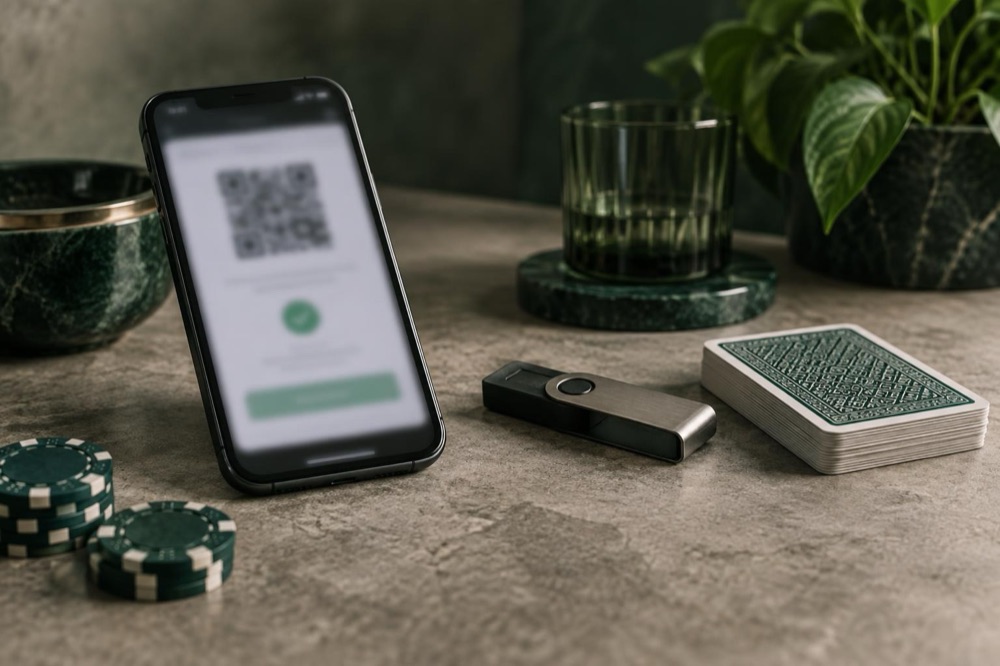
The mechanics, step by step:
- Open the cashier and select cryptocurrency.
- Choose the coin and network. USDT on TRC20 is the common choice because fees are low and confirmations are fast.
- Copy the deposit address, or scan the QR code.
- Send from your exchange account or personal wallet. Check the network matches exactly.
- Wait for confirmations. The site credits your balance automatically.
Deposit limits at offshore sites that accept Indian players typically run from INR 250 to INR 50,000 for crypto1. Some sites charge no deposit fees for crypto, which is one of the reasons players switch7.
The catch is the on-ramp. To get crypto, you buy it, usually on an Indian exchange or through peer-to-peer trading. That step is where your bank sees the transaction, and where the same risk controls can apply. Once the coins are in your wallet, the transfer to a betting site is invisible to your bank.
Crypto is not recognized as legal tender in India, and it cannot be used to settle legal wagers4. That is the line. Holding and transferring crypto is fine. Using it to fund a bet that Indian law does not permit does not become fine because the payment rail is different.
If you want the mechanics in more detail, see how crypto deposits and withdrawals work at gambling sites and USDT and stablecoins for gambling.
Taxes on winnings: 30% TDS and up to 35.53%
Tax is where UPI and crypto stop being different. All real money gaming apps in India are required to deduct tax at 30% on your net winnings at the time of withdrawal, or on March 31 at the end of the financial year, whichever comes first5.
Net winnings means total withdrawals minus total deposits, not each individual bet. That is the part players get wrong. A few worked examples make it clear.
Example 1: a winning session. You deposit INR 2,000 and withdraw INR 3,000. Net winnings are INR 1,000. Tax at 30% is INR 300, so you receive INR 2,7005.
Example 2: a losing session. You deposit INR 6,000 and withdraw INR 5,000. Net winnings are negative INR 1,000. No tax is deducted, and you receive the INR 5,0005.
Example 3: a break-even withdrawal. You deposit INR 2,000 and withdraw INR 2,000. Net winnings are zero. No tax is deducted, and you receive INR 2,0005.
Example 4: tax already paid. Over the year you deposit INR 8,000 and withdraw INR 9,000. Net winnings are INR 1,000, and INR 300 was already deducted earlier. No further tax is taken, because the same INR 300 is not charged twice5.
Example 5: year end. Your net winnings for the year are INR 500, so the tax is INR 150. If INR 100 was already deducted during the year, the remaining INR 50 is taken from your closing balance of INR 1,000, leaving INR 950 to carry into the new financial year5.
The same 30% applies to winnings from lotteries, horse races, crossword puzzles, card games, gambling and betting once they exceed INR 10,0009. Horse racing is not treated differently. The withholding rule applies to the winnings, not to the format.
The "up to 35.53%" figure you may see quoted comes from adding surcharge and cess on top of the base rate for higher income bands. For most players, the number that matters is the flat 30% deducted at source.
Penalties for players caught gambling illegally
Penalties for players in India are light by regional standards, but they are real. Under the Public Gambling Act, 1867, being found in a gaming house carries a fine of up to INR 100 or imprisonment for a term not exceeding one month9. That is the colonial-era statute that still underpins much of the state-level framework.

The practical risk is not the fine. It is everything around it: money lost to a site that never pays, an account frozen while a payment is investigated, and the fact that you have no legal route to recover funds from an operator that is itself operating illegally in India.
For context on how much harsher the rules are elsewhere in Asia, Hong Kong's Gambling Ordinance carries a maximum fine of HKD 50,000 and nine months' imprisonment for betting with an illegal bookmaker10. Singapore imposes a fine of up to S$5,000 or a six-month prison sentence on individuals who gamble unlawfully11. Mainland China treats cross-border gambling as an administrative offense with detention and fines, and criminal liability where a crime is constituted12. India sits at the lenient end of that range.
What the law does not settle: state-by-state powers
India's federal gambling ban applies nationally, but states are given the power to decide whether the ban applies across their territory13. That is why the picture looks inconsistent: casinos operate in two states, lotteries run in some states and not others, and rummy is treated as a game of skill in some jurisdictions.
The forms of gambling currently legal in India are state-run lotteries in some states, horse racing, rummy card games, and casinos in two states14. Horse racing has been recognized as permitted throughout India, with the state deriving revenue from it15. Betting is permitted on the day of the race and in the enclosure where the race is run, with government sanction, and horse racing is excluded from state gambling acts9.
Online gambling is not on the legal list. Under the Information Technology Act, 2000, all forms of online gambling are illegal, though that Act was originally put in place to regulate cybercrime14.
For visitors and foreign residents, the state you are in matters more than your passport. If you are in a state with a licensed casino, you can walk in. If you are in a state without one, the same activity is not available to you. Age rules follow the same pattern: India does not set one national gambling age, and where gambling is legal, most jurisdictions require players to be 18 or older, with casino entry at 21 in some places16.
If you want the country-level picture, start with Can I gamble in India?. For the payment side more broadly, see gambling payments in Asia and instant bank transfers for gambling.
Common Questions
Do I have to pay tax on winnings deposited back to my UPI account?
Yes. Tax is deducted at 30% on your net winnings at the time of withdrawal, or on March 31 at the end of the financial year, whichever comes first. It applies to the money you win, not to the method you use to receive it, so a UPI payout is taxed the same as any other.
What is the legal gambling age in India?
India does not set one national gambling age. Where gambling is legal, most jurisdictions require players to be 18 or older, and casino entry in some places is 21. If you are a visitor, carry ID, because age checks at the door are common.
Which forms of gambling are currently legal in India?
State-run lotteries in some states, horse racing, rummy card games, and casinos in two states. Online real-money gambling is not on that list. Everything else, including betting on offshore sites, sits outside what Indian law permits.
Can tourists be jailed for gambling in India?
Tourists are not exempt. Penalties for gambling offenses in India are light by regional standards, but they exist, and a foreign visitor caught in a gaming house faces the same rules as a resident. Stick to licensed venues and legal formats.
Is horse racing taxed differently from other winnings?
No. Winnings from horse races fall under the same 30% withholding rule as lotteries, card games and betting, once they exceed INR 10,000. The tax treatment is the same whether you bet at the track or through an app.
Do crypto deposits avoid the UPI block on betting sites?
They route around it, but they do not make the underlying activity legal. Crypto is not banned in India and is not recognized as legal tender, so it cannot be used to settle legal wagers. Many offshore sites accept it because banks cannot block a wallet transfer.
What happened to the zero-MDR rule on UPI payments?
India repealed the statutory bar on UPI merchant discount rates in August 2026, so UPI payments may now carry a fee. In practice, most consumer UPI transfers are still free, but the rule that guaranteed zero cost is gone.
Sources16 sources
- Payment options, NextBet, September 26, 2026
- Fun88 deposit, Fun88, April 10, 2026
- India Gambling PDF, Khaitan & Co, 2026
- Cryptocurrency and gambling in India, Lexology, June 8, 2021
- TDS on winnings, RummyCircle, September 25, 2026
- Google Pay online casinos India UPI guide, Gamble Press, January 8, 2026
- How to deposit with cryptocurrency, SportsBetting.ag, June 3, 2026
- Common UPI deposit issues, Roobet, November 19, 2024
- Gambling in India, University of Bath, 2017
- Gambling Ordinance, Hong Kong Government, June 4, 2025
- Remote Gambling Act, Singapore Statutes Online, November 26, 2014
- Cross-border gambling penalties, Chifeng Public Security Bureau, February 6, 2026
- Visa debit India, Wizard of Odds, September 26, 2026
- Gambling in India, London School of Hygiene and Tropical Medicine, 2017
- Supreme Court ruling on horse racing, Supreme Court of India, March 26, 1959
- Gambling report, Hong Kong Home Affairs Bureau, 2011















