What a social casino app is
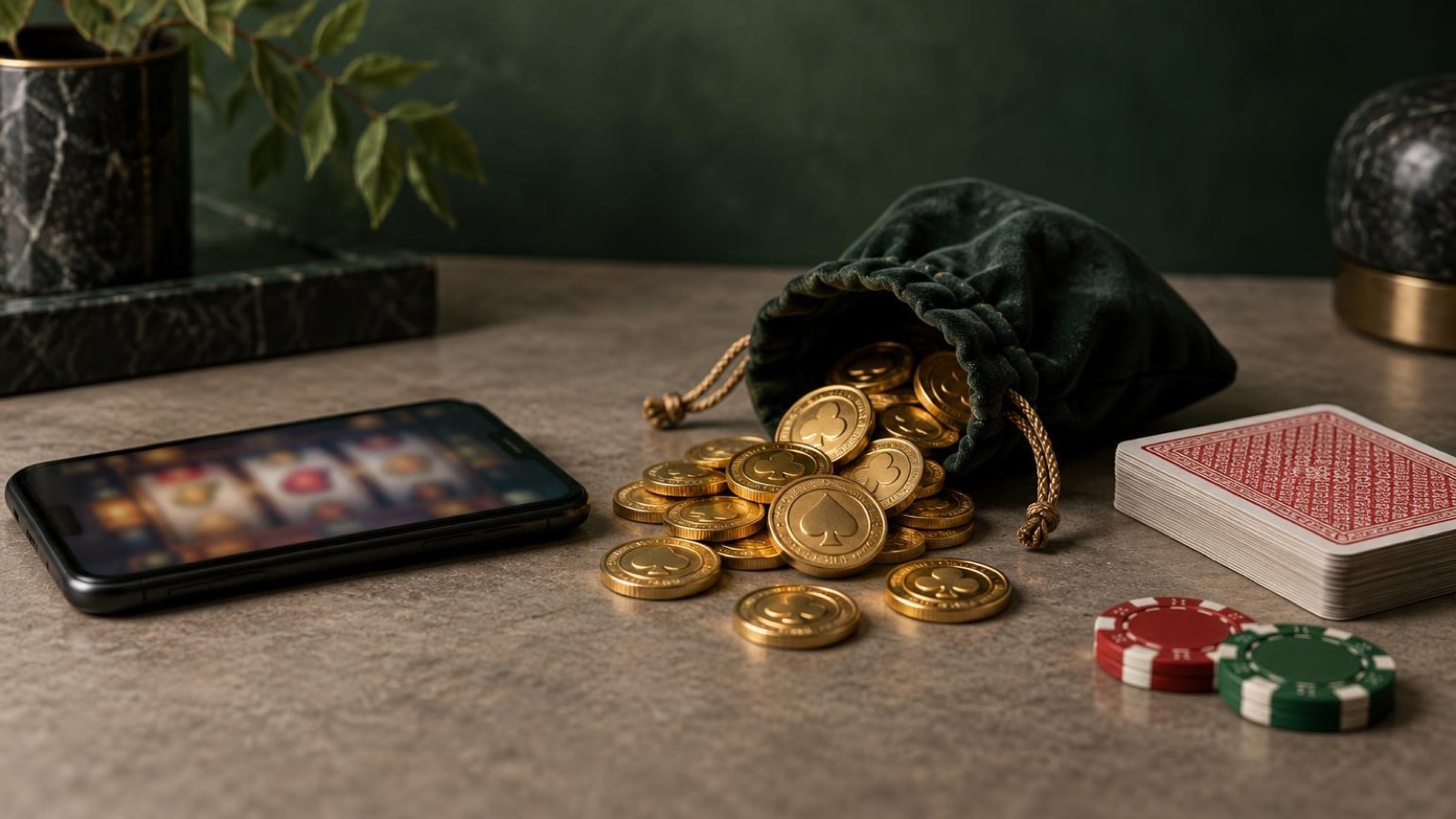
A social casino app is a free-to-play game that looks and feels like a casino but does not pay out real money. You spin slots, play poker hands or sit at a blackjack table, and you win virtual coins. The coins buy more spins, unlock characters or decorate a profile. They do not leave the app.
The best-known examples are Doubledown Casino, Slotomania and Zynga Poker, the kind of games you find on social media platforms such as Facebook1. They are free to play, and they are built for the social side: leaderboards, gifts between friends, daily bonuses8.
These games are not confined to Facebook any more. They are freely available on social networks, websites, apps, smartphones and tablets, and popular titles include Lightning Slots and Golden City Casino9. You can install one in a minute and be spinning within five.
The important thing to notice is what the app is selling. It is selling entertainment, not a chance at money. Some social casino games advertise unusually high pay-out rates and higher probabilities of winning compared with real gambling, precisely because the coins are not worth anything8. A high virtual pay-out rate costs the operator nothing.
Are social casino apps gambling? What the law looks at
The law does not ask whether a game looks like a casino. It asks whether something of value is staked for a chance to win something of value. If the coins cannot be cashed out, traded or sold, the second half of that test fails, and the app sits outside gambling law.
Singapore's Gambling Control Act 2022 draws the line explicitly. It excludes "social gambling" from the definition of unlawful gambling, so gambling that is not social gambling but is unlawful betting, unlawful gaming or unlawful participation in a lottery falls on the other side5. The same Act carves casino gambling and social gambling out of its section 31 offense5. In plain terms: a private game among friends with no house taking a cut is treated differently from a commercial betting operation.
China's approach is similar in effect, though it is expressed through enforcement guidance rather than a single Act. Mahjong or card games with money stakes among family members or relatives, played without a profit motive, are not treated as gambling, and games with small stakes among non-relatives are not punished6. The same principle appears in guidance stating that recreational mahjong is not treated as gambling and generally not punished when it is not for profit, involves small stakes, or takes place in a chess and card room that charges only fixed venue and service fees10.
The test has a subjective element. To decide whether mahjong or poker playing is gambling, the player must intend to gain property through gambling, and actual gain is not required11. That is why the same game can be legal on a kitchen table and illegal in a back room: the question is what the players are there for.
Where the line is crossed, the consequences are real. Playing mahjong or poker in a chess and card room becomes illegal under the Public Security Administration Punishment Law, and in some cases criminal under the Criminal Law, when the games are used as gambling tools11. Enforcement notices list the forms targeted:
- gambling for profit through electronic game machines
- chess and cards
- mahjong
- dominoes
- dice
- Mark Six lottery
- the internet
- WeChat red packets
- Texas Hold'em12
Japan is the strictest of the group and the simplest to state. Online casinos are illegal, and connecting to an online casino website from Japan to gamble is a crime even if the casino is legally operated overseas5. The National Police Agency puts it in one line: baccarat, slots, sports betting and the rest, regardless of the name or content, are crimes when conducted online3. A foreign license does not justify it, and a mistake about the illegality does not negate intent4.
So the answer to the headline question depends entirely on one feature: whether the virtual coins can become real money. If they cannot, you are playing a game. If they can, you are gambling, and the country you are sitting in decides whether that is allowed.
| Type of app | Legal? | Where | Minimum age |
|---|---|---|---|
| Free social casino app, coins cannot be cashed out | Generally yes | Most of Asia | Set by the app store, usually 12+ or 17+ |
| Sweepstakes or coin app with cash-out | Treated as gambling | Depends on jurisdiction; illegal in Japan | 18 or 21, per local gambling law |
| Real-money online casino | Illegal in Japan, China, Thailand and others | Offshore sites accessible but unlawful | 18 or 21, per local gambling law |
Mahjong Soul: riichi mahjong with character collecting
Mahjong Soul is the clearest example of a free game that borrows the shape of gambling without any of the money. It is a Chinese-made game that features Japanese rules, meaning riichi mahjong2. You play four-player or three-player matches, and you collect characters along the way.
Every new player starts with the same two characters: Ichi-hime and Miki Nikaidou2. Both are available to all new accounts. Everything else is unlocked through play or through in-game purchases, not through wagering.
The three-player mode uses tsumo-son scoring, the same convention used by other Japanese mahjong clients such as Tenhou, Maru-Jan and Mahjong Ichiban Street2. If you already play riichi mahjong elsewhere, the scoring will feel familiar.
Why does this matter for the legal question? Because the game has no cash-out. You cannot convert your rank, your characters or your in-game currency into money. Winning a hand gives you a better position and progress toward unlocks. That is the whole reward.
It also matters because mahjong itself sits in a gray zone in several Asian jurisdictions, and the gray zone is about stakes, not about the game. Mahjong among relatives and friends is legal entertainment, protected by law, when it is not for profit, the winnings are small, and it is only leisure7. The same tiles, played for profit, are a different matter entirely.
If you want the country-by-country picture for real-money play, the Japan guide and the China guide set out what residents and visitors can and cannot do. For the wider regional view, Online Gambling in Asia: The Law for Players in 12 Jurisdictions covers all twelve.
Tongits Wars: a free card game that reached number one in the Philippines
Tongits Wars was a free-to-play Filipino card game built on tongits, a rummy-style game popular in the Philippines. It was free to download, free to play, and it made money from optional in-app purchases rather than from real-money wagering. At its peak it reached the top of the app charts in the Philippines.
It is no longer available. The game was removed from the app stores, and the shutdown is best understood as part of the wider regional pressure on gambling-adjacent apps rather than as the result of a single published ruling. If you search for it now, you will find third-party pages and old reviews, not a working download.
The Philippines does have a regulated online gambling sector, and that is a separate thing entirely. PAGCOR maintains a register of accredited gaming system administrators and registered brands, and licensed operators appear on it under names such as Game88, Lucky88, Play88 and Sports8813. A licensed operator with a PAGCOR-accredited system is not the same as a free card game, and the two should not be confused.
For players, the practical lesson from Tongits Wars is that a free game can disappear. If an app has no real-money element, you lose nothing but your progress when it goes. If you have paid for chips or cosmetics, you lose those too, and there is usually no refund route.
If you want to know what is actually licensed and legal in the country, the Philippines guide covers the regulated market, and Legal Online Betting and Lottery Accounts in Asia: What Exists Where lists what is available where.
What free-to-play does not include: real-money payouts
This is the part that decides everything. A free-to-play app has no cash-out. A sweepstakes or coin-based app that lets you convert virtual coins into money, gift cards or transferable credit is not free-to-play in the legal sense, whatever the marketing says.
The distinction shows up in how regulators describe the products. Social casino games are described as free-to-play games available on social media platforms, with no real-money payout8. Once a game enables players to wager real money, it has crossed into a different category, and the unusually high pay-out rates that social games advertise stop being a marketing point and start being a regulatory problem8.
China's guidance is the clearest statement of where the line sits for recreational play. Recreational activities with small money stakes, not for profit, and businesses such as chess and card rooms that charge only normal venue and service fees, are not treated as gambling14. The same principle is repeated in guidance covering residents: recreational gambling is not treated as gambling if it is not for profit, involves small winnings and losses, or takes place in a venue charging only normal fees15.
Vietnam draws a related line around the technology used. Using the internet, computer networks, telecom networks and other electronic means to gamble online falls under the aggravated offense provisions, while merely using messaging to communicate, such as recording numbers or betting on horse races, without forming an online game, does not16. The medium matters as much as the stake.
Japan's position is the one to remember if you are there. Online casino gambling is illegal regardless of the name or content of the game, including baccarat, slots and sports betting3. That covers a coin-based app with a cash-out feature just as much as it covers a conventional offshore casino. If you are in Japan and the app can pay you, do not use it.
For the wider picture of what happens when players use offshore sites, Have Players Been Arrested for Online Gambling in Asia? Cases by Jurisdiction sets out the cases. If you are weighing up a site that promises a cash-out from virtual coins, When an Online Gambling Site Won't Pay Out: What Players Can Do covers what your options look like, and Fake and Rigged Online Casinos: How Scam Gambling Sites Work explains how the coin-to-cash pitch is used as a hook.
One more practical point. Apps that let you cash out coins usually require identity verification before they pay, which means handing over your ID and often your bank details to an operator you have no way to check. KYC on Gambling Sites: Why They Ask for ID and What Happens to It explains what that process involves.
Common Questions
Is Mahjong Soul free to play?
Yes. Mahjong Soul is a free-to-play riichi mahjong game. You download it, play matches against other people, and collect characters and cosmetics. There is no real-money wagering built into the game itself, and no cash payout for winning a hand.
Which characters can new Mahjong Soul players start with?
Every new player starts with two characters: Ichi-hime and Miki Nikaidou. Both are available to all new accounts from the start. Additional characters are unlocked through play or in-game purchases, not through betting.
What is riichi mahjong?
Riichi mahjong is the Japanese variant of mahjong. It uses Japanese scoring and rules, including the riichi declaration, and is the version played in Mahjong Soul. It differs from the Chinese, Taiwanese and Filipino variants in scoring and in how a hand is completed.
Why was Tongits Wars shut down?
Tongits Wars was a free-to-play Filipino card game that reached the top of the app charts. It was removed from app stores, and the shutdown is widely associated with the wider crackdown on gambling-adjacent apps in the region rather than with any single published court ruling.
Can I play Tongits Wars offline?
No. Tongits Wars was an online multiplayer game. It required a network connection to match you with other players, so there was no offline mode. With the game shut down, there is no official way to play it now.
Did Tongits Wars cost money to play?
No. Tongits Wars was free to download and free to play. It made money from optional in-app purchases such as chips and cosmetics, not from real-money wagering. You never had to deposit money to sit at a table.
Sources16 sources
- All About Gambling, Responsible Gambling Council, 2026
- Chinese Anime and Japanese Mahjong, Baker Institute, 2023
- Online Casino Information, National Police Agency (Japan), 2026
- Online Casino Guidance, National Police Agency (Japan), 2026
- Gambling Control Act 2022, Singapore Statutes Online, 2024
- Notice on Applying the Law in Gambling Violation Cases, Jiangsu Provincial Government, 2019
- Mahjong and Card Games Among Relatives, Shaanxi Procuratorate, 2026
- Gaming and Gambling, Responsible Gambling Council, 2026
- Gaming and Gambling (Chinese), Responsible Gambling Council, 2026
- Mahjong Entertainment and the Law, China Peace, 2023
- Guidance on Gambling Determination, Beijing Municipal Government, 2020
- Gambling Crackdown Notice, Dingcheng District Public Security Bureau, 2020
- List of PAGCOR Accredited Gaming System Administrators, PAGCOR, 2025
- Interpretation on Gambling Criminal Cases, Chinese Embassy in Malaysia, 2026
- Recreational Gambling Guidance, Beijing Shijingshan District Government, 2025
- Online Gambling Liability Guidance, Thu Vien Phap Luat, 2018