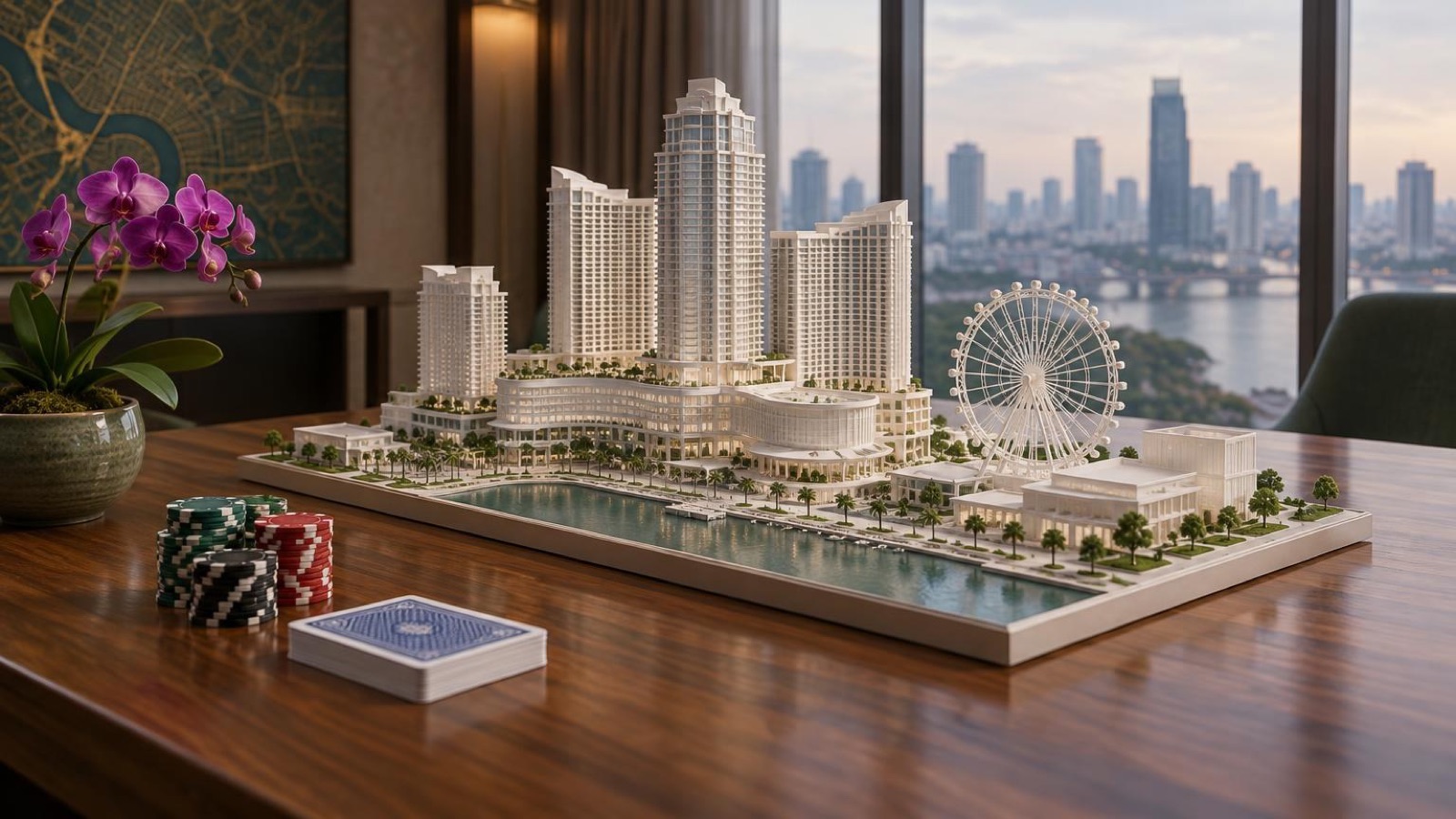
Thailand has spent years working on a plan to open casinos for the first time in modern history, and the shape of that plan is now fairly clear. The government wants large integrated resorts, officially called entertainment complexes, built in tourist areas, with casino floors open to foreign visitors on easy terms and to Thai nationals on much stricter ones. The cabinet approved the Entertainment Complex Bill on January 13, 2025, and the draft was expected to be enacted in early 20261. Nothing is open yet, and nothing will be until the law is in force and licenses are granted, but if you are wondering what a legal Thai casino would look like, who could walk in, and what already exists today, this page covers it.
What the complexes would actually be
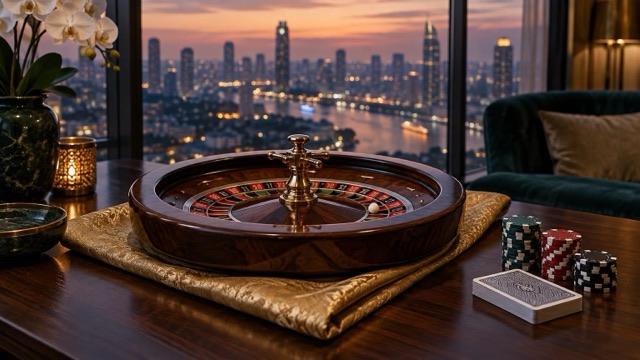
The word to watch is "entertainment complex," not "casino." The draft law requires each licensed venue to be a large mixed-use development, not a standalone gambling hall. The complexes are envisioned as developments of around $2.9 billion, featuring five-star hotels, theme parks and casinos6. The idea follows the Singapore and Macau model: a family-friendly resort where the casino is one attraction among many, which is how the government sells the plan to a public that is wary of gambling.
Each complex would need to meet investment and facility requirements set out in the law, and the casino portion would be a defined space inside the resort rather than the whole property. That matters for visitors: even if you have no interest in gambling, these would be places with hotels, dining, shows and shopping that you could enjoy like any resort. The casino floors themselves would have the entry rules described below.
The bill's stated aim is to capture tourism and tax revenue that currently leaks to Cambodia, Macau and other neighbors, and to bring some of the enormous underground gambling market into the open. Analysts have suggested the plan could put Thailand behind only Las Vegas and Macau in gaming revenue if it is fully built out7.
Where the complexes would go
The draft law points to specific tourist zones: Bangkok, Pattaya, Phuket and Chiang Mai are the named candidates8. An earlier government panel proposed five complexes, one for each region of the country9. Pattaya has been named as the target for the central region, and Chiang Rai or Chiang Mai for the north9.
| Region | Candidate location |
|---|---|
| Central | Pattaya (two complexes in Bangkok were also proposed) |
| East | Eastern Economic Corridor |
| North | Chiang Rai or Chiang Mai |
| South | Phuket |
Nothing is confirmed. Locations depend on which investors win licenses and on final decisions by the government, which the bill gives the final say over9. But the pattern is consistent across every version of the plan: the complexes go where foreign tourists already are, not in provincial towns.
One project already has a site and a name. The Royal Turf Club, which lost its old Bangkok racecourse in 2018, is planning "The Royal Siam Haven" on a 1,200-rai plot in Bangkok, with construction expected to take seven years13. More on that below.
Entry levy: 5,000 baht for Thai nationals, free for foreigners
The entry rules split sharply by nationality:
| Who | Entry fee | Extra requirement | Minimum age |
|---|---|---|---|
| Foreign visitors | Free | Passport at the door | 20 |
| Thai nationals | 5,000 baht per entry | 50 million baht in deposits | 20 |
Thai nationals must pay an entry fee of 5,000 baht, roughly US$143 to $148 depending on the exchange rate, each time they enter the casino1. The fee appears in every version of the draft, from the first cabinet-approved text through the later amendments, and it is designed to make casual visits by Thais expensive.
The comparison people usually make is with Singapore, which charges its own citizens and permanent residents an entry levy while letting foreigners in free. Thailand's draft takes the same idea but goes further, pairing the 5,000 baht fee with the deposit requirement in the next section.
Foreigners will need a passport. The regulations require foreigners to present a passport or an equivalent document at the door, and visitors must register and pay any applicable fee on entry15. So bring your passport the way you would at any casino in the region.
The 50-million-baht deposit rule for Thai visitors
The fee is only half of it. Under the draft law, a Thai national who wants to enter a casino floor must show proof of at least 50 million baht in bank deposits, about US$1.47 million, held in a fixed deposit account continuously for no less than six months3. The requirement survived into the amended draft in early 2025 and, despite criticism, stayed in the bill for now4.
The practical effect is that the casinos are effectively reserved for the richest Thais. Press coverage at the time put it plainly: only Thais with at least 50 million baht in the bank can enter4. For foreign visitors and expatriate residents who are not Thai nationals, none of this applies; you walk in free with a passport.
Minimum age: 20 and ID checks
The bill sets the minimum gambling age at 20, and anyone under 20 is prohibited from entering the casino venues7. That applies to Thais and foreigners alike. Expect ID checks at the entrance as a matter of course, the same as at any licensed casino in Asia.

Note that 20 is the Thai standard, not the 21 used in Manila and most of the United States.
What the bill does not cover: online gambling
The Entertainment Complex Bill is land-based only. It did not address online gambling at all5. There is no legal sportsbook, no legal online casino, and no legal bookmaker of any kind in Thailand, and the bill does not create any5. The old Gambling Act does not cover online gambling directly, but it bans nearly all wagering activities, so online play remains illegal in practice even though no law names it specifically17.
This matters because some coverage of the casino plan creates the impression that Thailand is "legalizing gambling." It is not. It is legalizing casinos inside licensed resorts, and nothing else. If you are looking for the current state of play online, see our page on online gambling in Thailand.
Taxes and government revenue
The draft proposes a 17 percent tax on gross gaming revenue from the casinos7. Player earnings from the complexes would also be subject to a 17 percent tax under the bill's terms8. Earlier versions of the plan talked about the government collecting 30 percent in taxes from each entertainment complex, so the final number has moved around as the draft has been negotiated9.

The revenue case is the reason the government keeps pushing the plan despite the controversy. Supporters argue licensed complexes would pull money out of the underground economy, where illegal gambling is rampant, and into taxed, regulated venues. How much actually arrives depends on how many complexes get built and whether the Thai entry rules are relaxed enough to let locals spend.
Horse racing: the legal betting that already exists
While the casino plan waits, Thailand already has legal betting, and it is older than most visitors realize. Under the Gambling Act B.E. 2478 of 1935, the only legal forms of gambling have been the government lottery and domestic horse racing18. Betting on boxing is also allowed in practice20. Everything else, including every casino game you can name, has been illegal, which is why the entertainment complex plan is such a break with the past.
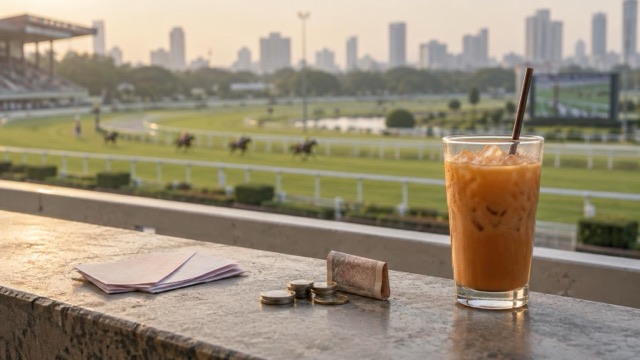
Horse racing is where the story connects to the casino plan. Bangkok had two tracks: the Royal Bangkok Sports Club and the Royal Turf Club's Nang Loeng racecourse on Phitsanulok Road in Dusit district, founded in 191613. Betting on races at the two tracks was legal, in person only5.
The Royal Turf Club ran its last race at Nang Loeng on September 16, 2018, and closed, because its lease contracts with the Crown Property Bureau had expired and were not renewed11. The club said it would continue as an association and negotiate debt deferrals with creditors until it could organize racing again21.
Its comeback plan is the project mentioned earlier: The Royal Siam Haven, on a 1,200-rai plot in Nong Chok district in eastern Bangkok, with a new racecourse as the main building13. The full project is planned to include:
- A golf course and yacht club
- A sports complex
- A six-star hotel and luxury restaurants
- A wellness hospital
- A casino, if the law passes13
The casino part cannot proceed until the Entertainment Complex law comes into force; the club has said plainly that the casino has not yet been approved and cannot be built now, but that a legal casino is planned for the site if the law passes22. Construction was expected to start the year after the 2024 announcement and take seven years, with the project expected to become visible around 202713.
So the short version of where Thailand stands: legal betting today means the lottery, horse racing and boxing; the two Bangkok tracks are down to one plus a plan; and the first legal casinos, if the law holds together, will sit inside billion-dollar resorts aimed squarely at foreign visitors, with the door for Thai nationals left only slightly ajar.
Common Questions
How much is the casino entry fee for foreigners in Thailand?
Nothing. Under the draft law, foreign visitors enter the casino floors free of charge, while Thai nationals pay a 5,000 baht entry levy each time. Foreigners show a passport at the door.
Can Thai citizens gamble in the proposed casinos?
Yes, but with heavy conditions. A Thai national must be at least 20, pay 5,000 baht per entry, and show proof of at least 50 million baht held in a bank deposit for six months or more.
When will Thailand's entertainment complexes open?
No date is fixed. The bill was approved by the cabinet in January 2025 and was expected to be enacted in early 2026, but complexes would still take years to build. The Royal Siam Haven project alone is budgeted at seven years of construction.
Is online gambling legal in Thailand under the new bill?
No. The Entertainment Complex Bill covers land-based venues only and does not address online gambling at all. There is no legal online casino, sportsbook or bookmaker of any kind in Thailand.
What happened to the Royal Turf Club at Nang Loeng?
It closed in September 2018 after its lease with the Crown Property Bureau expired and was not renewed. The final race was run on September 16, 2018, and the club said it would negotiate debt deferrals until it could organize racing again.
Where is the new Bangkok racecourse planned?
In Nong Chok district in eastern Bangkok, as part of a 1,200-rai project called The Royal Siam Haven, which is also planned to include a golf course, yacht club, six-star hotel and, if the law passes, a casino.
How many casinos will Thailand have?
The plan points to around five licensed complexes: two in Bangkok and one each in the Eastern Economic Corridor, Chiang Mai and Phuket, though nothing is confirmed until licenses are actually granted.
Sources23 sources
- Thai cabinet approves casino bill, Bangkok Post, 2025
- Thai cabinet approves draft law for casinos, with limits for local gamblers, The Straits Times, 2025
- Casino entry reserved for richest Thais only, Bangkok Post, 2025
- B50-million bank balance requirement stays in casino bill, for now, Bangkok Post, 2025
- Thailand iGaming and Payments 2026: What's Legal and How It Works, LinkedIn, 2026
- Thailand Poker Guide, SoMuchPoker, 2026
- Casino plan could put Thailand behind only Las Vegas and Macau, Business Times, 2025
- Legalising casinos in Thailand: a deeper dive, Bangkok Post, 2025
- Panel touts a casino for each region, Bangkok Post, 2022
- Thai govt finalises casino legalisation bill, Bangkok Post, 2024
- Royal Turf Club runs its last race, Bangkok Post, 2018
- Royal Turf Club plans new track, Bangkok Post, 2018
- Horse racing club plans Bangkok casino, Bangkok Post, 2024
- Thailand legalizes casino entertainment complex, AP News, 2025
- Casino entry fee schedule (Royal Gazette document 129915), Ratchakitcha Sapa, 2026
- Thai cabinet approves draft law to legalise casinos and gambling, Bangkok Post, 2025
- Gambling in the Kingdom, Part Two, Bangkok Post, 2013
- Phumtham lifts ban on poker, but details still to be worked out, Thai Newsroom, 2025
- Gambling Act B.E. 2478 (1935), Wikipedia, 2026
- Thailand's big casino gamble hangs on fine print, Bangkok Post, 2025
- Curtains for the Royal Turf Club at Nang Loeng, The Nation, 2018
- The Royal Siam Haven project page, Wikipedia, 2026
- The Royal Siam Haven construction timeline, Sanook, 2024