

What odds represent: the payout multiplier
Odds are an approximate multiplier showing what you get back if your ticket wins6. That is the whole idea in one line. If a price is 4.5, a winning unit stake returns about 4.5 times that stake.
The multiplier tells you two things at once: how much you stand to collect, and how likely the market thinks the outcome is. A lower number means more people are backing that selection and your return is smaller. A higher number means fewer are, and the payout is bigger5. At Kasamatsu Keiba, the odds board shows this directly: in the sample prices, brackets 3 and 5 have the smallest multipliers, which marks them as the popular picks7.
For fixed odds bets, the operator states the fixed odds at which your stake will be multiplied if the selection wins8. That is the number you are agreeing to. It is not a forecast you are buying into; it is the price of the bet.
A few practical consequences follow from that:
- Your stake is multiplied by the price, not added to it.
- The price you see is the price you get, provided the bet is accepted at that moment.
- In a multiples bet, the payout is the stake multiplied by the odds of each individual selection9.
Why odds change from moment to moment
Odds move because the money moves. In pari-mutuel horse racing, the payout rises and falls depending on how many people buy a given horse or bracket and how much they put on it, so the odds change from moment to moment6. The numbers are calculated by computer and displayed on large screens and odds boards around the venue7.
Fixed odds markets move for a different reason. The operator may change the fixed odds for a bet type at any time before bet placement10. Two things drive that: new information that affects the likely result, and the operator's own book. At Sports Toto in South Korea, odds can change due to factors affecting the match result and to manage the annual average refund rate, and anyone who bought before the change is settled at the odds at the time of purchase11.
In-play markets move fastest of all. In live handicap betting, the handicap line and the odds change according to how the match develops12. The same applies to Asian Handicap generally: handicap lines and odds will change during betting2.
The important protection for you is the same in every case. Once your bet is accepted, the fixed odds recorded in the operator's official record are the odds used to calculate your payout, and neither the operator nor the bettor may change them for a valid bet, regardless of later movement13.
Opening lines and the trader's role
An opening line is the first price a bookmaker puts up on a market. In horse racing, the equivalent is the morning line: odds set by the track handicapper for individual horses before betting opens14. It is a starting point, not a final answer, and it exists so that bettors have something to react to.
For sports, the operator sets the opening price by estimating the expected result. At Sports Toto, odds are set by the operator based on the expected match result, taking into account team records, past results, injuries, recent form, media coverage, popularity and other factors11. That list is the job description of an odds compiler: gather what is known, weigh it, and turn it into a number.
Once the market is open, the price is managed rather than merely published. The operator may change the fixed odds for a particular bet type at any time10. In practice that means a trader is watching where the money goes and adjusting the price to keep the book balanced and the margin intact.
Some markets are more mechanical than others. In craps, the dealers handle money and chips, exchange cash for chips, pay winning bets, clear losing bets, mark the point and help players place bets in hard to reach spots15. That is a table game with fixed payouts rather than a priced market, but it shows the same principle: the house sets the terms, and the staff enforce them.
For football, the operator decides which bet types to offer and when. It may decide from time to time which fixed odds bet types are offered for one or more races or a race day, and may at its discretion offer in-play betting on any fixed odds bet types at any time13. So the menu itself is a decision, not a fixed list.
The margin: how bookmakers build in a profit
The margin is the operator's cut, and it is built into the prices rather than charged as a separate fee. You never see a line item for it. You see it in the fact that the odds on offer are slightly shorter than the true chances would justify.
The clearest example in Asia is pari-mutuel horse racing in Japan. At the point of buying a ticket, roughly 20 to 30 percent of the money is already lost, and 70 to 80 percent of sales proceeds is distributed as the refund total3. That gap is the takeout. It comes out of the pool before anyone is paid.
Fixed odds operators build the margin differently, by shading each price. The effect on you is the same: the payout is a little smaller than a fair price would be. If you want to see the arithmetic, fair odds walks through removing the margin from a two-way price, and vigorish explains the commission built into two-way odds.
There are also smaller deductions and rounding rules that affect what actually lands in your account:
- Winnings on fixed odds football bets are calculated to the nearest 10 cents, up or down16.
- In a dead heat, the stake on each winning selection is divided into equal parts equal to the number of dead heat winners; the payout is one part multiplied by the fixed odds, and the remaining stake is treated as a losing bet17.
- At some racecourse bookmakers, a 3 percent charge inclusive of tax is collected toward administration18.
None of these are hidden, but they are easy to miss if you only look at the headline price. Payout rounding covers how dividends and winnings are rounded across the region.
Parimutuel odds: when bettors set the price themselves
In pari-mutuel betting, the price is not set by a bookmaker at all. Pari-mutuel means a system of betting where winners share the net pool in proportion to their stakes19. Everyone's money goes into one pool, the operator takes its deduction, and the remainder is divided among the winning tickets.
That has a few consequences you can feel at the counter:
- The final dividend is not known until betting closes, because it depends on how much was bet on each outcome.
- The dividend is always declared to a unit bet, so you can compare prices across pools21.
- The operator decides which pari-mutuel bet types to offer on a nominated match or matches21.
- Horse racing operators commonly offer both pari-mutuel and fixed odds betting on races22.
The pool system is why tote odds move continuously. Odds are updated according to how much bettors wager on each horse, right up until the race starts14. A horse that attracts a flood of late money will shorten, and everyone who backed it earlier gets a smaller share than they might have expected.
Singapore Pools declares winnings per unit bet from the net betting pool divided by the number of unit bets on the winning combination, and may declare winnings in multiples of S$1 rounded down to the nearest dollar, or in fractions of a dollar20. That rounding is part of the pool mechanics, not a separate charge. Pari-mutuel dividends goes through the calculation in full.
Where to check current odds
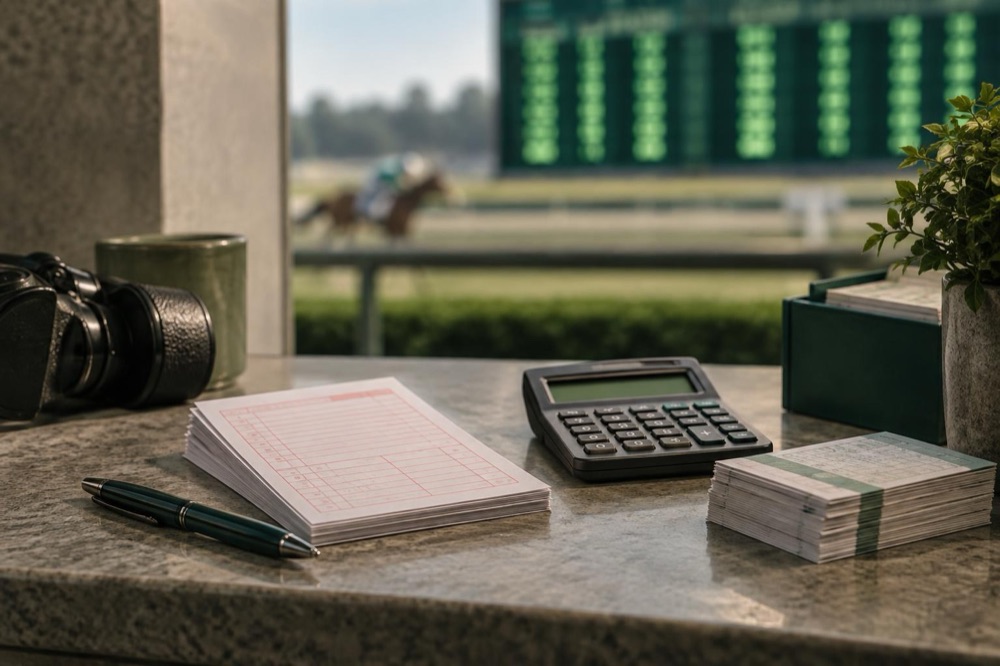
At a racecourse, odds are shown on monitors inside the venue4. The large boards in the betting hall display the same numbers, and at Japanese tracks the odds are recalculated by computer and pushed to those screens as money arrives7.
Online, the odds shown are those at the moment you access the page, so you need to refresh to see the latest23. That is worth remembering before you commit: a price you saw ten minutes ago may not be the price on offer now.
For the difference between a price you take now and a price declared later, see starting price and final odds.
Cutoff times: when betting closes
Cutoff times vary by operator and by bet type, so check the specific market before you plan around it.
The table below sets out when betting closes or stays open for each of these markets.
| Market | When betting closes or continues |
|---|---|
| Win and place betting at Japanese racecourses | Odds change constantly until the cut-off time for placing bets, which is two minutes before post time; that is the hard stop for win and place betting on the day4. |
| Asian Handicap football | Bets may be placed after kickoff, in the midst of the match, and in-play handicap markets stay open as the game runs, with the line and the odds adjusting to the score and the flow of play9. |
| Jockey Challenge | Bets may be placed until the start of the second last race; selling is suspended at the start of each race and resumes after the weighed in signal is displayed24. |
One rule that catches people out: if you accept a cash-out offer, the bet is treated as immediately abandoned by you, and later revisions to the result are treated as invalid for that bet25. Once you take the cash-out, the market is closed for you.
If you are new to a jurisdiction and want to know what is legal where you are, the country guides cover the practical position: Hong Kong, Japan, Singapore, South Korea and India each set out what residents and visitors can and cannot do.
Common Questions
What do odds mean in simple terms?
Odds are an approximate multiplier showing what you get back if your ticket wins. A price of 4.5 means a winning unit stake returns about 4.5 times that stake. Lower odds mean more people are backing that selection and your return is smaller; higher odds mean fewer are, and the payout is bigger.
Why do odds get shorter on popular selections?
In pari-mutuel betting, the payout is shared among everyone holding winning tickets, so the more money on a horse or combination, the smaller each share becomes. In fixed odds betting, operators shorten prices on heavily backed selections to limit their liability. Either way, a smaller multiplier signals a more popular pick.
How often do bookmakers change their odds?
Fixed odds can be changed at any time before you place a bet, and in-play handicap lines and prices move as the match develops. Tote odds update continuously until the race starts. Once your bet is accepted, the price recorded at that moment is the one used to calculate your payout.
What is the margin and who pays it?
The margin is the operator's built-in profit, taken out of the prices rather than charged as a separate fee. In pari-mutuel horse racing in Japan, roughly 20 to 30 percent of the money is lost at the point of ticket purchase, with 70 to 80 percent of sales returned as payouts. Bettors pay it through shorter odds.
How are horse racing odds different from fixed-odds sports betting?
Horse racing is usually pari-mutuel: winners share the net pool in proportion to their stakes, so the final dividend is not known until betting closes. Fixed-odds sports betting locks in the price shown when you place the bet, and that recorded price is what your payout is calculated from.
When is the latest I can place a bet before a race starts?
It depends on the operator and the bet type. At Japanese racecourses, odds change constantly until the cut-off, which is two minutes before post time. Some football bet types allow bets after kickoff, and in-play markets stay open while the match runs.
Where can I see live odds at a racecourse?
At the track, odds are shown on monitors inside the racecourse and on the large odds boards in the betting hall. Online, the odds displayed are those at the moment you load the page, so refresh to see the latest before you decide.
Sources25 sources
- Football Rule 3, HKJC, January 17, 2026
- Sports Betting FAQ, Singapore Pools
- 競馬の払戻率に関する研究, National Tax Agency, June 2025
- Go Racing, Japan Racing Association
- オッズ, Keirin
- オッズ, Kasamatsu Keiba
- オッズ, Kasamatsu Keiba
- Horse Race Rule 5, HKJC
- Football Betting Game Rules, Singapore Pools
- Football Rule 3, HKJC, January 17, 2026
- 자주묻는질문, Sports Toto
- 讓球, HKJC
- Horse Race Rule 5, HKJC
- Understanding Odds, Ontario Racing
- How to Play Craps, PlaySmart
- 讓球主客和, HKJC
- Football Rule 3, HKJC
- Bookmakers Betting Rules, Hyderabad Race Club
- Football Rule 1, HKJC, January 17, 2026
- Horse Race Betting Game Rules, Singapore Pools, July 6, 2026
- Football Rule 4, HKJC, March 30, 2026
- Responsible Gambling, HKJC
- よくあるご質問, Keiba
- Horse Racing Guide, HKJC
- Football Rule 3, HKJC, April 29, 2026















