

Key facts
| Item | Detail |
|---|---|
| Type of venue | Licensed poker room1 |
| Branches | Ortigas (Pasig City) and Davao City1 |
| Games | Poker cash games and tournaments1 |
| Series guarantees | ₱11 Million, including side events1 |
| Hand rule | Do not reveal your live or folded hand; players not in the hand should not influence the play1 |
| ID needed | Valid photo ID (passport for visitors) |
| Membership required | No |
| Who may play | Citizens, residents and foreign visitors |
Where the Metro Card Club is
Metro Card Club operates two licensed poker rooms in the Philippines. The first is Metro Card Club - Ortigas, at G/F Bldg. C, Metrowalk Commercial Center, Meralco Avenue, Pasig City1. Metrowalk is a commercial complex along Meralco Avenue in Pasig, part of Metro Manila, and the card room sits on the ground floor of Building C. If you are coming from Makati or Ortigas Center, it is a short taxi or ride-hailing trip.
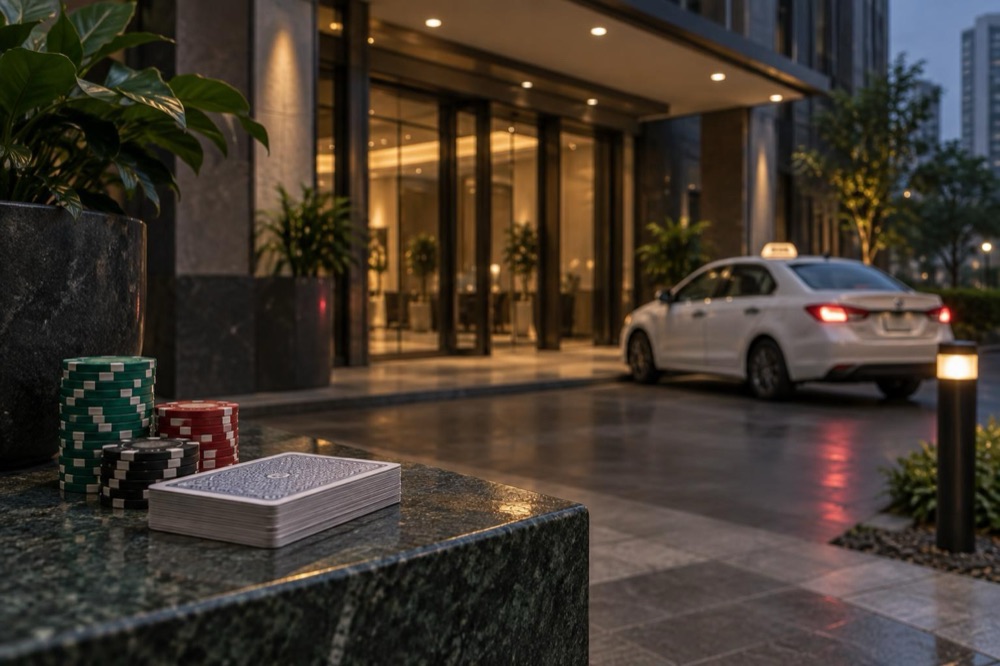
The second branch is Metro Card Club Davao, at #26 Jebo Bldg., Tionko Ave., Davao City1. Tionko Avenue is a central Davao street, and the Jebo Building is easy to find by taxi. Davao is in Mindanao, so this branch serves players in the south rather than the Manila crowd.
Both addresses come from the PAGCOR register of poker operators with issued gaming licenses, dated May 7, 20261. That register lists each venue by name, address and game type. Metro Card Club appears twice, once for each branch, and both entries show "Poker Room" as the game offered1.
If you are planning a poker trip around the region, the Philippines has a deep bench of licensed rooms. You can compare them on our casinos in the Philippines page, which covers who can go in and what to expect at each.
What the card room offers
Both Metro Card Club branches are licensed as poker rooms1. That means the games on offer are poker variants, not table games like baccarat or roulette. In practice, a Philippine poker room of this kind runs cash games and tournaments, and the license register classifies the venue by its primary game type rather than listing every variant1.
The PAGCOR register lists many other poker rooms alongside Metro Card Club, including Prime Poker Club Manila, Kings Poker Club, Masters Poker Club, 9D Poker Club, Red Dragon Poker Room and others1. That tells you the Philippine poker scene is broad, with rooms spread across Manila, Davao, Cagayan de Oro and other cities. Metro Card Club is one of the established names in that list.
For a sense of what the wider Philippine table game market looks like, including the games that run in the big integrated resorts, see our casino table games in the Philippines page. Poker rooms are a different animal from the resort casinos, but the two ecosystems overlap in Manila.
If tournaments are your thing, the Philippines also runs baccarat and table game tournaments at the larger resorts. Our baccarat and table game tournaments in Manila page covers those. Poker tournaments at a card room like Metro are a separate format, usually with a buy-in and a starting stack rather than a table game bracket.
Entry rules: who can play and what to bring
Philippine poker rooms are adult venues. You need to be 21 or over to enter and play. Bring a valid photo ID, such as your passport if you are a visitor or a Philippine driver's license or national ID if you are a resident. The room will check it at the door or at registration.
There is no membership requirement to walk in and play cash games at a licensed Philippine poker room. You register at the desk, show ID, and take a seat when one opens. For tournaments, you register and pay the buy-in before the event starts.
Foreign visitors and foreign residents are both welcome at licensed Philippine poker rooms. The Philippines does not restrict poker room entry by nationality the way some jurisdictions restrict their casinos. What matters is your age and your ID.
If you are new to Philippine gambling generally, our Philippines gambling guide explains what is legal, what is regulated and how the different venue types fit together. It is a useful starting point before you pick a room.
House rules: table stakes, binding declarations and seating
Poker rooms run on a set of house rules that keep the game moving and keep disputes to a minimum. The exact rule sheet varies by room, but the principles are consistent across licensed poker venues.
A declaration is binding. If you say "call" or "raise," that is your action, and the floor will hold you to it. If you say nothing and push chips forward, the amount you push is normally treated as your bet. Say what you intend before you move chips, especially in a raised pot.
Table stakes means you can only bet what you have in front of you at the start of the hand. You cannot reach into your pocket mid-hand to add chips. If you want to play a bigger game, you buy in for more before the hand begins.
Seating is controlled by the floor. You will be assigned a seat, and if you want to change tables or move seats, you ask the floor rather than moving yourself. In a busy room, the floor manages a waiting list and will call your name when a seat opens.
String bets are not allowed. A bet must be made in one motion. If you release chips in two separate motions, the floor will usually treat only the first motion as your bet. Announce your intention clearly before you act, and you avoid the problem entirely.
Conduct rules: language, threats and table etiquette
Poker rooms expect civil behavior at the table. That means no threats, no intimidation and no abusive language toward other players or staff. If a player crosses that line, the floor can warn them, penalize them or remove them from the room.
Language at the table is generally flexible in Philippine rooms. Filipino and English are both widely spoken in Manila and Davao, and dealers and floor staff work in both. If you are more comfortable in another language, you can usually speak it with your own group, but keep table talk in a language the dealer understands when it concerns the action.
Table etiquette matters more than most new players expect. Do not talk about a hand that is still in play if you are not in it. Do not reveal your cards to another player during a live hand. Do not slow the game down with long tanking on trivial decisions. These habits will get you a reputation fast in a room where regulars know each other.
Phones at the table are usually allowed for quick checks but not for extended calls that hold up the game. If you need to take a call, step away from the table. Most rooms will ask you to do this anyway.
Prohibited actions: chopping, insurance and side betting
A few actions are off the table in any licensed poker room, and Metro Card Club will be no different.
- Chopping. Splitting a pot between players without playing the hand out is not allowed in a cash game unless the room specifically permits it in a tournament situation. In a cash game, you play the hand. If you and another player want to avoid a confrontation, you can fold, but you cannot agree to split the pot.
- Insurance and side betting. You cannot make a private bet with another player on the outcome of a hand, and you cannot sell or buy a share of your action at the table. All betting runs through the house, and the house takes its rake or fee from the pot.
- Moving chips off the table. In licensed casino environments, transferring chips between customers is generally prohibited, and taking chips outside the gaming area is not allowed2. A poker room operates under the same principle: chips stay on the table or in the cage, and they do not move between players outside the game.
If you are unsure whether something is allowed, ask the floor before you do it. That is always the safer move.
Floor decisions and the house's right to close games
The floor has the final say on any dispute at the table. If there is a question about a bet, a misdeal, a string bet or a rule interpretation, the floor decides, and that decision stands for the night. Arguing with the floor after a ruling is a fast way to get asked to leave.
The house also has the right to manage the room as it sees fit. That includes opening and closing tables, changing game stakes, moving players and ending a game when it is no longer viable. In a licensed venue, the operator can restrict access or refuse service without giving a reason, a standard condition across regulated gaming3.
If a game breaks because too few players remain, the floor will close it and seat the remaining players elsewhere or put them on a list for a new game. This is normal and not personal.
If you break a house rule, the response depends on the rule and the situation. You might get a warning, have a hand declared dead, be asked to sit out, or be removed from the room. The floor's decision on the night is final.
Tournament series: flights, guarantees and side events
The Metro Card Club name is associated with tournament series that run in the Philippine poker calendar, typically with flights, guaranteed prize pools and side events. These series bring in players from across Asia and are a step up from the daily cash game grind.
A typical series format runs starting flights across several days, with players who survive a flight returning for Day 2. Guarantees are set by the operator and announced in advance. Side events usually include smaller buy-in tournaments, turbo formats and sometimes non-hold'em variants.
If you are planning to play a series, register early. Flights can fill, and late registration closes at a set level. Bring your ID, and check the schedule for the exact buy-in and starting stack before you commit.
For a broader look at how Philippine poker rooms and casino rewards programs work, our casino rewards cards and players clubs in Manila page explains the loyalty side of the market. If you want to see how a large integrated resort runs its poker room, the Solaire poker room page is a useful comparison.
Getting there and what to expect on the day
For the Ortigas branch, head to Metrowalk Commercial Center on Meralco Avenue in Pasig City. The card room is on the ground floor of Building C1. Taxis and ride-hailing apps both know Metrowalk. If you are driving, the complex has parking, though it fills up on weekend evenings.
For the Davao branch, the address is #26 Jebo Bldg., Tionko Ave., Davao City1. Tionko Avenue is central, and a taxi from most Davao hotels will get you there quickly. Ask the driver for the Jebo Building on Tionko.
On arrival, expect to show ID at the door or at the registration desk. For cash games, you will be added to a list and called when a seat opens. For tournaments, you register and pay the buy-in, then take your assigned seat before the cards go in the air.
Buy-ins vary by game and by the stakes running that day. The room will post the stakes for each table. If you are new, start at the lowest stakes available and watch a few hands before you sit down.
Dress is casual. There is no formal dress code at a Philippine poker room of this kind. Comfortable clothes are fine, and most players dress for a long session rather than for a night out.
Common Questions
Where is the Metro Card Club located?
Metro Card Club has two branches. The Ortigas room is at G/F Bldg. C, Metrowalk Commercial Center, Meralco Avenue, Pasig City. The Davao room is at #26 Jebo Bldg., Tionko Ave., Davao City. Both are licensed poker rooms in the Philippines.
How old do you have to be to play at Metro Card Club?
You must be 21 or over to enter and play at a licensed Philippine poker room. Bring a valid photo ID, such as a passport for visitors or a Philippine driver's license or national ID for residents. Staff check it at the door or at registration.
Do I need a membership to play at Metro Card Club?
No. There is no membership requirement to walk in and play cash games at a licensed Philippine poker room. You register at the desk, show ID, and take a seat when one opens. For tournaments, you register and pay the buy-in before the event starts.
Can foreign visitors play at Metro Card Club?
Yes. Foreign visitors and foreign residents are both welcome at licensed Philippine poker rooms. The Philippines does not restrict poker room entry by nationality the way some jurisdictions restrict their casinos. What matters is your age and your ID.
What games does Metro Card Club offer?
Both branches are licensed as poker rooms, so the games on offer are poker variants rather than table games like baccarat or roulette. In practice, a Philippine poker room of this kind runs cash games and tournaments.
Is there a dress code at Metro Card Club?
Dress is casual. There is no formal dress code at a Philippine poker room of this kind. Comfortable clothes are fine, and most players dress for a long session rather than for a night out.
Sources3 sources
- List of Poker Operators with Issued Gaming License, PAGCOR, May 7, 2026
- Chip Handling and Money Regulations, Japan Casino Regulatory Commission, 2026
- Betting Facilities Rule 9, Hong Kong Jockey Club, 2020







