What skin betting and real money betting are
What it is
Skin betting and real money betting both let you put something at risk on the outcome of an esports match. The difference is what you put at risk and what you get back.
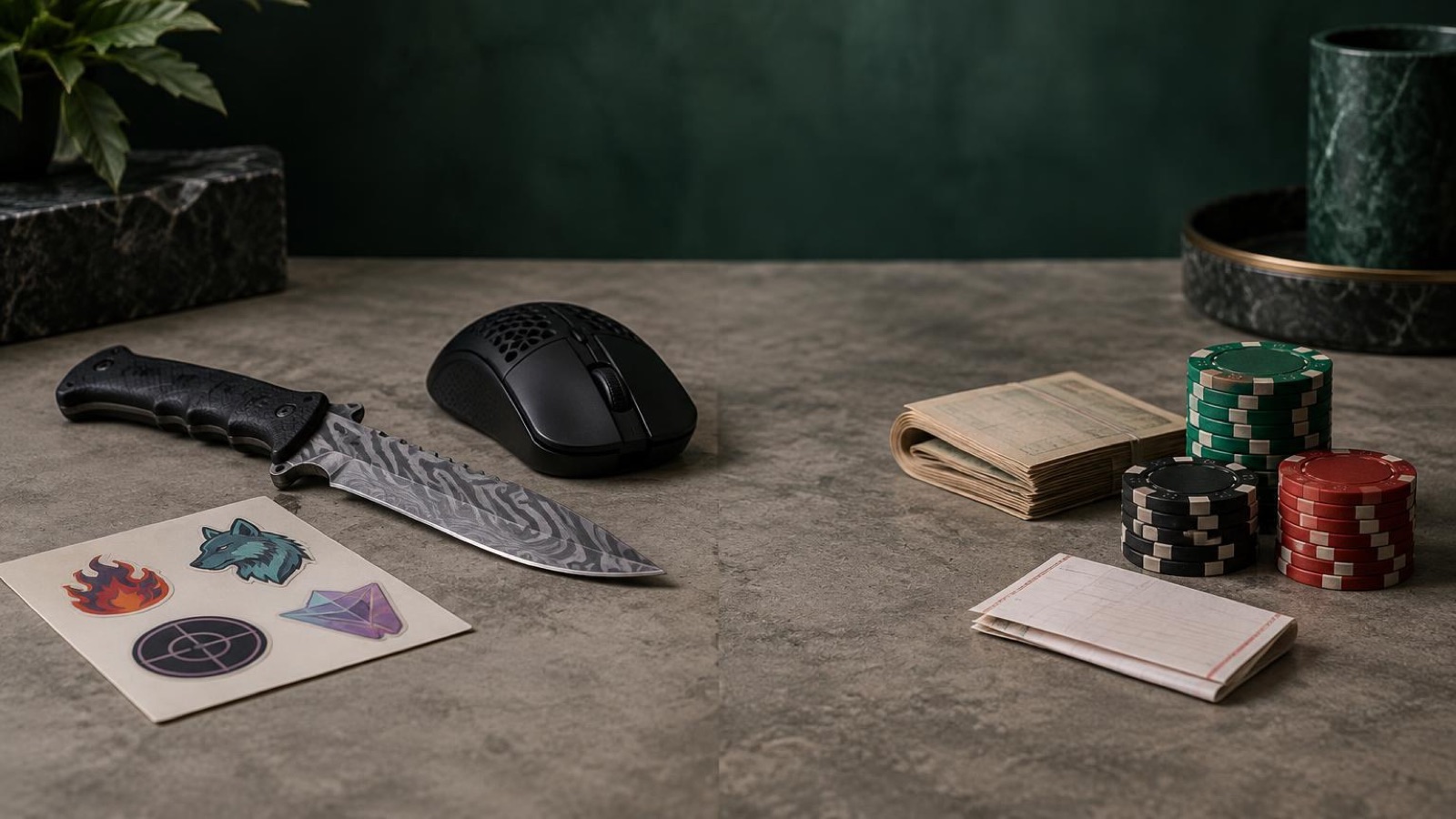
With skin betting, the stake is a virtual item. In CS2 that usually means a weapon skin, a knife or a sticker, and the site holds it in escrow while the match plays out. If you win, you get skins back. If you lose, the skins are gone. The site itself is not a licensed bookmaker in most cases, and it does not pay you in currency. You would have to sell the skins you win somewhere else to turn them into cash, and that step is where a lot of the practical risk sits.
With real money betting, the stake is cash from your account. You deposit, you place the bet, and the operator settles it in currency. A licensed operator issues terms that cover registration, deposits, withdrawals, identity checks and responsible gambling, separate from the betting rules that govern how markets settle2. That separation matters: it means there is a documented process if a market is voided, a match is postponed or you want to withdraw.
The two also differ in what you can bet on. Skin sites historically focused on a narrow set of markets, mostly match winner on CS:GO and Dota 2. Real money books cover a much wider board.
| Operator | Coverage |
|---|---|
| One operator | Lists 7,574 sports markets on its sportsbook5 |
| Another | Covers esports markets including total kills, map winners and live props like First Blood across League of Legends, Dota 2, Valorant and CS26 |
| A third | Lists prop bets such as total kills, First Blood, map winners and specific in-game achievements in live mode4 |
If you want the mechanics of how a match bet settles, that is covered in how esports betting works. If you want the full menu of markets, see esports bet types and esports prop bets.
Licenses and regulator
This is the cleanest dividing line between the two.
A real money operator normally holds a license and says so. Nextbet states plainly that it is licensed and regulated7. Licensed operators in regulated markets sit under a named authority, and that authority sets the rules the operator has to follow. In Mauritius, for example, the Gambling Regulatory Authority Act 2007 sets out what betting operations may and may not do, including a prohibition on placing a cash bet in a casino and a Gaming House A8. In Hong Kong, the Jockey Club's eWin service is an account-based web betting service that requires proof of age, and the Club itself notes it differs significantly from most gambling sites3. Hong Kong also restricts payment methods: basketball betting license conditions do not allow credit card bets3.
Skin betting sites generally do not hold a bookmaker license. They operate as item marketplaces or game-skin economies, and the wagering happens on top of that. That is the structural reason they are hard to regulate: there is no cash deposit, no cash withdrawal and often no identity check, so the usual licensing hooks do not apply.
The practical consequence for you is simple. If something goes wrong on a licensed book, there is a regulator and a complaints route. If something goes wrong on a skin site, there usually is not.
Where it accepts players
Real money operators are explicit about who they take and how you pay.
- Stake lets players deposit, bet and withdraw using a variety of popular cryptocurrencies at both its casino and sportsbook9, and its casino supports local currencies alongside Bitcoin10.
- Fortunejack separates its betting rules from its operator terms, so account registration, deposits, withdrawals, KYC and responsible gambling sit under the operator's terms rather than the betting rules2.
- Bitcasino.io offers two modes: a fun mode where you try games without funds, and a real mode for real money betting11.
Skin sites work differently. They accept items, not currency, and they pay out in items. There is no deposit in the banking sense, no withdrawal to a bank account, and no KYC step in the normal flow. That is convenient, and it is also why the sites sit outside the licensed system.
For a country-by-country view of where real money accounts can be opened and used, the visitor and expat guide covers accounts, travel and the law. If you specifically want to know how skin sites work, what is skin betting goes through skins, case opening and skin gambling sites.
The legal position by country
Skin betting and real money betting are treated differently in most of Asia, and the split is not always where you would expect.
In India, horse race betting is treated as a game of skill rather than chance, a classification supported by the Supreme Court of India, and a license is typically required where it is permitted under state law12. The same source notes that fantasy sports, previously permitted in certain states as games of skill, are now prohibited under the PROG Act to the extent those games include monetary stakes12. Older research on Indian gambling law makes the same point about horse racing being deemed a game of skill13.
In Thailand, the Gambling Act BE 2478 prohibits almost all forms of betting and games of skill or chance with a real money stake, with exceptions for the State Lottery and horse racing14. That is a real money prohibition. It does not say anything about skins, because skins were not a category when the law was written.
In Vietnam, the online betting business is prohibited15. Again, that is aimed at real money betting operations, not at item trading.
The pattern across the region is that real money betting is named, defined and either licensed or banned. Skin betting mostly falls into a gap: it is not cash, so it is not always caught by the wording of gambling statutes, but it is also not clearly permitted. Some jurisdictions treat skins as virtual goods and leave them alone. Others treat wagering skins as gambling and apply the same rules as cash.
The practical answer is that skin betting is not automatically legal just because it is not cash. The rules vary by where you are. The dedicated page on skin betting legality goes through this in more detail, and the country guides cover the real money side: India, Thailand, Vietnam, Japan, South Korea, Singapore, Malaysia, Philippines, Hong Kong, Macau, Cambodia and China.
Games and payments
The games overlap more than the payments do.
On the real money side, licensed operators in the Philippines are registered for specific product types. The PAGCOR register lists operators for Electronic Casino Games and Sports Betting, for Sports Betting and Electronic Bingo Games, and for Sports Betting alone16. That tells you the licensed product set is defined and audited.
Esports markets on licensed books are broad. GG.BET lists total kills, First Blood, map winners and specific in-game achievements in live mode4. CoinPoker covers total kills, map winners and live props like First Blood across League of Legends, Dota 2, Valorant and CS26. Sportsbet.io labels the winner market as the winner or 1x2 market17. A moneyline bet is simply a bet on the team or player you think will win, with no points or goals spread involved18. Live in-play betting means placing bets during a match after it has started, with odds changing in real time based on what is happening on court19. In football, an in-play handicap bet on the full time result is adjusted by a handicap line that changes as the match develops20.
Skin sites historically offered a narrower set. Research on the skin economy describes Max+ as allowing users to bet on both traditional sports and esports competitions using game skins, mainly Dota 2, or M coins1. The same research describes C5game as facilitating jackpot-style gambling events where players use real money to pay for website coins for a chance to win high-value skins1. That is the key mechanical difference: on C5game you are buying site coins with real money first, then wagering those coins. You are not depositing into a licensed account.
Payments follow from that. Licensed books use cash, cash vouchers or a betting account, unless the operator declares otherwise21. Some markets restrict specific methods: Hong Kong basketball betting license conditions do not accept credit card bets3. Skin sites take items and pay items, and the conversion to cash happens off-platform.
One more difference worth knowing: some online gambling sites offer a free practice mode. With personal data given, the player receives a free prize usable for real bets and real winnings; without personal data, the player receives only credit for betting with no real winnings22. That is a real money operator feature, and it is a useful way to try markets before staking anything.
Ownership and history
Skin betting grew out of the CS:GO item economy. Skins had resale value, trading was open, and sites built wagering on top of the trading system. That worked until it did not.
Real money esports betting followed a different path. It grew inside the licensed sportsbook system, which already had deposit rules, identity checks, dispute processes and responsible gambling tools. Operators added esports markets to an existing regulated product rather than building a parallel economy. That is why a licensed book today can offer total kills, First Blood and map winners4 alongside traditional sports markets, and why the account, payment and complaint structures are the same ones used for football or tennis.
The practical upshot: skin betting is a smaller, less regulated market than it was a decade ago, and real money esports betting is a mainstream product inside licensed sportsbooks. If you want to bet on esports with money, the licensed route is the one with a paper trail. If you want to understand the skin side, start with what is skin betting and loot boxes vs skin betting.
Common Questions
Is skin betting the same as real money betting?
No. Skin betting wagers virtual items such as CS2 weapon skins, which have resale value but are not cash. Real money betting uses actual currency through a licensed sportsbook or casino, with deposits, withdrawals and identity checks.
Can you withdraw real money from skin betting sites?
Usually not directly. Most skin sites pay out in skins or site coins, which you then have to sell elsewhere to get cash. That extra step adds risk, and many sites have no cash withdrawal option at all.
Why did Valve shut down skin betting sites?
Scandals over underage gambling and match fixing forced Valve to shut down most CS:GO skin betting sites in 2016. The sites relied on Steam's trading system, and Valve cut off that access.
Is skin betting legal in Asia?
It varies. Some countries treat skins as virtual goods and do not cover them under gambling law, while others treat skin wagering as gambling. Check your local rules before using any skin site.
What age do you need to be for real money esports betting?
Most licensed operators require you to be at least 18, and some jurisdictions set the bar at 21. You will normally need photo ID and proof of address to open and verify an account.
Do real money esports books offer the same markets as skin sites?
Often yes, and more. Licensed books cover match winner, map winner, handicaps, totals and props like total kills and First Blood, plus live in-play markets that most skin sites do not offer.
Sources22 sources
- Skin betting research, Cogent Social Sciences
- Sportsbook FAQ, Fortunejack
- Basketball betting licence conditions, Hong Kong Government
- GG.BET esports, GG.BET
- Stake, Stake
- CoinPoker games, CoinPoker
- Nextbet, Nextbet
- GRA Act 2007, Gambling Regulatory Authority Mauritius
- Swapped crypto deposit integration, Stake
- Stake Casino, Stake
- Pending payout in online casinos, Bitcasino.io
- India Gambling, Khaitan & Co
- Gambling in India, University of Bath
- Best for players from Thailand, Wizard of Odds
- Bo Tai chinh chua cap chung nhan cho kinh doanh dat cuoc, Bao Chinh Phu
- List of PAGCOR accredited Gaming System Administrators, PAGCOR
- Must know terms for smart bettors, Sportsbet.io
- What is a moneyline bet, Betway
- How to bet on tennis, bet365
- In-play bet types, Hong Kong Jockey Club
- Betting Facilities Rule 2, Hong Kong Jockey Club
- Gambling study Thailand, Gambling Study Thailand