Sports betting odds are essential for determining potential payouts and understanding the probability of an event occurring. Whether you’re new to sports betting or looking to refine your approach, learning how sports betting odds work will give you a better chance of making informed wagers. Odds are displayed in different formats: American, decimal, and fractional, and they represent the likelihood of an event happening while helping bettors calculate winnings.
Check out the best bonus deals before Midnight tonight!


How Do You Read Odds in Sports Betting?
To read odds in betting, you need to understand how they reflect the likelihood of an outcome and how they determine potential payouts. Odds indicate the ratio of the stake to the winnings, helping bettors assess risk and reward before placing a bet.
When reading betting odds, the higher the number, the less likely the outcome, meaning a larger potential payout. Conversely, lower odds suggest a higher probability but a smaller return.
For example, decimal odds of 2.50 mean that for every $1 wagered, the total payout is $2.50 (including the initial stake). Similarly, fractional odds of 5/1 mean you win $5 for every $1 bet. In American odds, a positive number (e.g., +200) represents how much profit you’d earn on a $100 bet, while a negative number (e.g., -150) shows how much you need to bet to win $100.
By learning how to read odds effectively, you can make better-informed bets and compare values across sportsbooks to maximize your potential payout.
Types of Sports Betting Odds Explained
There are a few different ways to read odds are displayed across online sportsbooks and physical betting venues. However, it’s important that you understand the three main types of odds:
American Odds
Also called moneyline odds, American betting odds are the most widely used format in U.S. sportsbooks. Understanding how to read odds in this format is crucial for making informed betting decisions. These odds are displayed as either a negative or positive number, indicating the potential payout or required wager.
- Positive odds (e.g., +200) show how much profit you would make on a $100 bet. For instance, if you wager $100 on a team with +200 odds, you stand to gain $200 in profit, totaling a $300 payout.
- Negative odds (e.g., -150) indicate how much you need to bet to win $100. If a favorite is listed at -150 odds, you must risk $150 to earn a $100 profit.
To effectively read odds, remember that a negative number signifies a favorite, while a positive one represents an underdog. For example, if a football team has odds of -200, you need to bet $200 to win $100. Conversely, if an underdog has odds of +300, a $100 wager would return $300 in profit. The ability to read odds correctly can help bettors assess risk and potential return before placing a bet.
Decimal Odds
Decimal odds represent the widely used odds in Europe, Canada, and Australia. Unlike American odds, decimal odds reflect the total payout rather than just the profit. To properly read odds in this format, simply multiply your stake by the decimal figure.
For example, with odds of 2.50, a $100 bet would yield a total return of:
100 × 2.50 = 250
This includes your original bet and a $150 profit.
To further simplify how to read odds in decimal format:
- Odds lower than 2.00 indicate a favorite, meaning the potential return is less than double the wager.
- Odds higher than 2.00 suggest an underdog, where the profit exceeds the original stake.
Because decimal odds clearly display total returns, they are often easier to work with than fractional or American odds, making them a preferred format for many international bettors.
Fractional Odds
Fractional odds, commonly seen in horse racing and UK sportsbooks, are displayed as fractions (e.g., 5/1 or 7/2). Learning to read odds in this format is essential for calculating potential payouts accurately.
- In a 5/1 scenario, a $100 wager would result in a $500 profit plus your original stake, giving a total payout of $600.
- With odds of 7/2, a $100 bet would return a profit of $350, totaling $450 with the initial stake included.
To read odds in fractional format, remember that the numerator (first number) represents potential winnings per unit wagered, while the denominator (second number) shows the bet size required for that return. If you see odds of 3/2, you stand to win $3 for every $2 staked.
Fractional odds can seem complex at first, but once you understand how to read odds in this format, you can quickly assess your potential returns. Many professional bettors still prefer fractional odds due to their long-standing use in horse racing and European markets.
Understanding Point Spread and Moneyline Wagers
Point Spread
Point spread odds are used to balance betting action by giving a hypothetical advantage or disadvantage to one team. A point spread might look like this in an NFL game:
Team A (-6.5) vs. Team B (+6.5)
If you bet on Team A, they must win by more than 6.5 points for your bet to win. If you bet on Team B, they must either win outright or lose by fewer than 6.5 points.
Moneyline Bets
A moneyline bet is straightforward: you pick which team will win. Unlike point spreads, the margin of victory doesn’t matter, just whether the team wins or loses.
For example, an MLB moneyline might look like this:
- Yankees -180
- Red Sox +150
A $180 bet on the Yankees would win $100, while a $100 bet on the Red Sox would win $150.
Calculating Implied Probability
Implied probability helps bettors understand the likelihood of an event occurring based on the odds offered. It is calculated differently for positive and negative odds:
Positive odds: 100/(positiveodds+100)×100
For +200 odds: 100/(200+100)×100=33.33%
Negative odds: ∣negative odds∣/(∣negative odds∣+100)×100
For -150 odds: 150/(150+100)×100=60%
The break-even percentage is another way to analyze odds. It tells bettors the probability needed to bet profitably over the long run.
Parlay Bets and Prop Bets
Parlay Bet
A parlay bet combines multiple wagers into one, increasing the potential payout but also making it harder to win. Each bet within the parlay must win for the entire bet to be successful.
Prop Bets
Prop bets focus on specific outcomes within a game rather than the final score. Examples include:
- Which player will score first in a football game
- Total passing yards by a quarterback
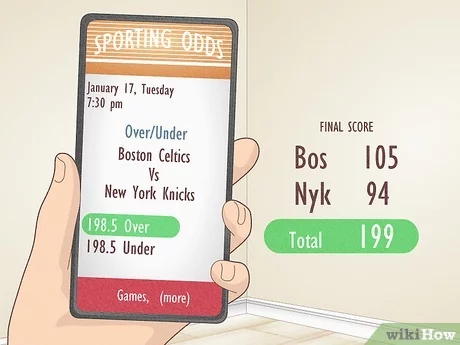
- Combined scores of both teams
How Sports Betting Odds Change and What to Look For
Sports betting odds change based on betting activity and other factors, such as injuries or weather conditions. Higher odds indicate a lower probability of an event occurring, while lower odds suggest a greater chance. Understanding how much potential profit you stand to make and how to read betting odds effectively will help you make smarter initial wagers.
Final Thoughts on How to Read Odds in Sports Betting
To be successful in sports betting, understanding how to read odds is essential. Whether you prefer American, decimal, or fractional odds, knowing how to calculate implied probability and total payout will give you an advantage. By analyzing point-spread bets, moneyline odds, and potential winnings, you can place more informed wagers and maximize your betting experience. Don’t forget to familiarize yourself with the different sports betting terms.
Frequently Asked Questions
What does a +200 odds mean?
A +200 odds in American odds means that if you place a $100 bet, you will win $200 in profit if your bet wins, plus your original stake for a total payout of $300. These betting odds indicate an underdog bet, meaning the particular outcome is less likely compared to a negative number (e.g., -150), which signifies the favored team.
This means a potential payout of 3x of the initial stake. In fractional odds, +200 is written as 2/1, meaning for every 1 unit wagered, you win 2 units in profit.
In European odds, which use decimal odds, this would be represented as 3.00, as shown in the above example. Understanding how odds work helps bettors make better decisions when placing underdog bets or predicting possible outcomes. Please refer to the above example for the computation.
What do 3 to 1 odds mean?
A 3 to 1 odds (or 3/1 in fractional odds) means that for every 1 unit of money bet, you win 3 units in profit if your winning bet is successful.
In decimal odds, it is represented as:
(3/1)+1=4.00(3/1) + 1 = 4.00
This means a potential payout of 4x the bet amount, including the original stake.
In American odds, 3 to 1 odds convert to +300, meaning a $100 bet wins $300 in profit, totaling $400.
The implied probability is:
(3+1)1×100=25%
This suggests a 25% chance of the particular event happening in a sporting event.
3 to 1 odds are considered favorable odds for higher payouts but indicate a lower probability of success. Understanding how to read odds helps bettors make better decisions when placing wagers.
What does negative 1.5 mean in betting?
A negative 1.5 (-1.5) in betting typically refers to a point spread or run line in sports betting. It means the favored team must win by at least 2 points/runs for a winning bet to be successful.
When you read odds, -1.5 in American odds is often associated with a spread bet rather than a traditional moneyline bet. It signifies that the team is giving a 1.5-point handicap to the opponent.
In decimal odds, a corresponding bet might have odds of 1.67 (depending on the sportsbook). This means a potential payout of 1.67x the initial stake if the bet wins. For fractional odds, this could be represented as 2/3, meaning a $3 bet returns $2 in profit if successful.
A minus sign in American odds (-150, for example) also reflects how much you need to bet to win $100. The implied probability of a -1.5 spread bet varies based on the attached odds, but it typically reflects a favored team with a greater likelihood of winning by the required margin.
Understanding how to read odds and interpret spreads is essential for making informed betting decisions.