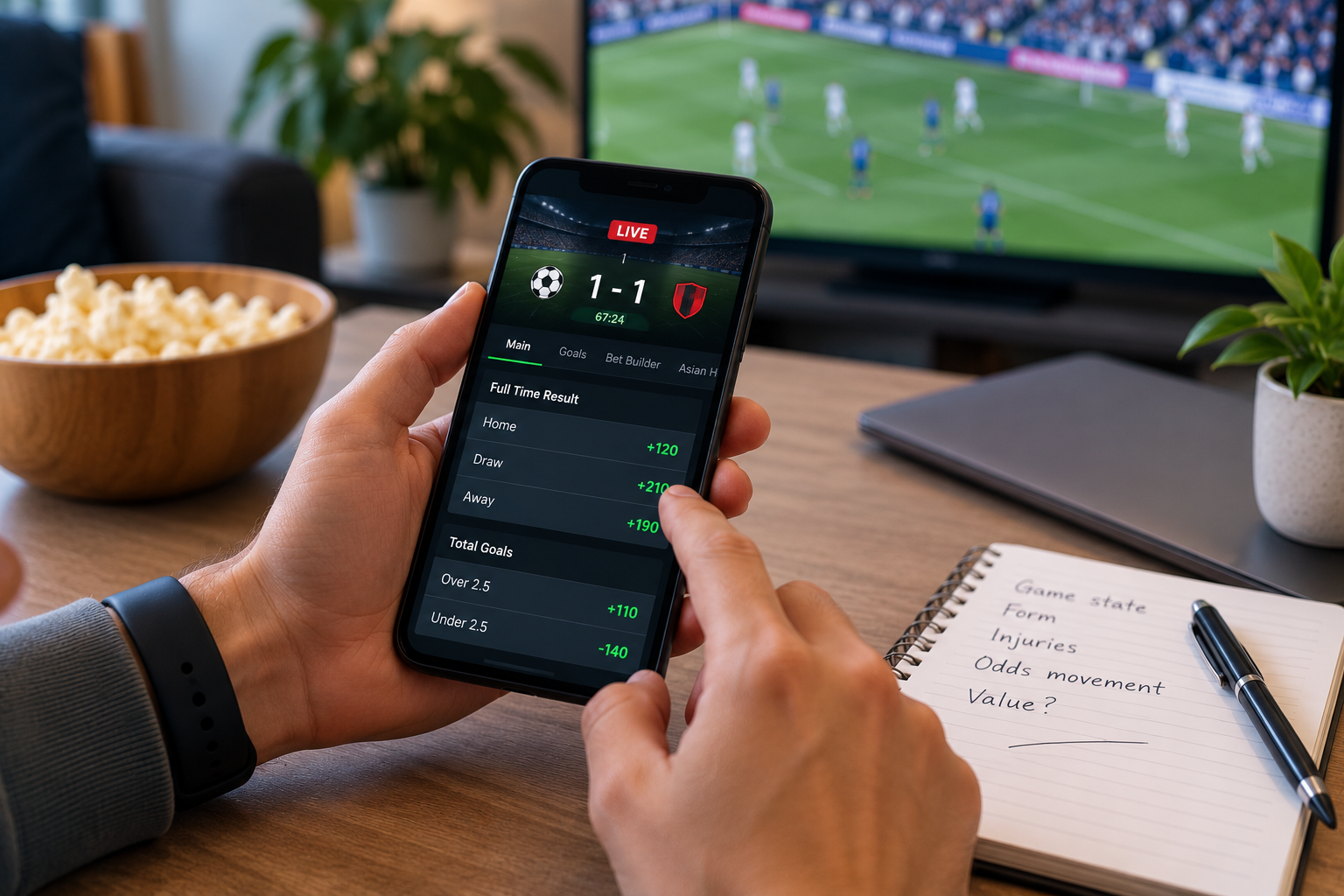

Live betting moves quickly. Odds can change after a goal, turnover, injury, substitution, timeout, or even a short period of sustained pressure. That speed creates opportunities, but it also makes it easy to confuse a tempting price with genuine value.
Learning how to identify value bets in real time starts with one principle: odds and probability aren’t the same thing. A sportsbook gives you a price. Your job is to determine whether that price accurately reflects the likelihood of the outcome.
A value bet exists when the probability implied by the available odds is lower than your estimate of the event’s actual probability. Finding that discrepancy during a live event requires fast calculations, disciplined observation, and an understanding of what information the market has already incorporated.
Check out the best bonus deals before Midnight tonight!


What Is a Value Bet?
A value bet is a wager where the offered odds imply a lower probability than you believe the outcome actually has.
Suppose a sportsbook offers +150 on a team to win. American odds of +150 correspond to an implied probability of 40%. If your analysis suggests that team actually has a 45% chance of winning from the current game state, the price potentially offers value.
That doesn’t mean the bet will win. A 45% probability still means the outcome would be expected to lose more often than it wins.
Value betting is about the relationship between probability and price rather than predicting individual outcomes correctly. Over a sufficiently large sample, consistently paying less than your estimate of fair value is the underlying idea behind positive expected value betting.
Live betting makes this more difficult because both probability and price can change every few seconds.
How to Identify Value Bets in Real Time
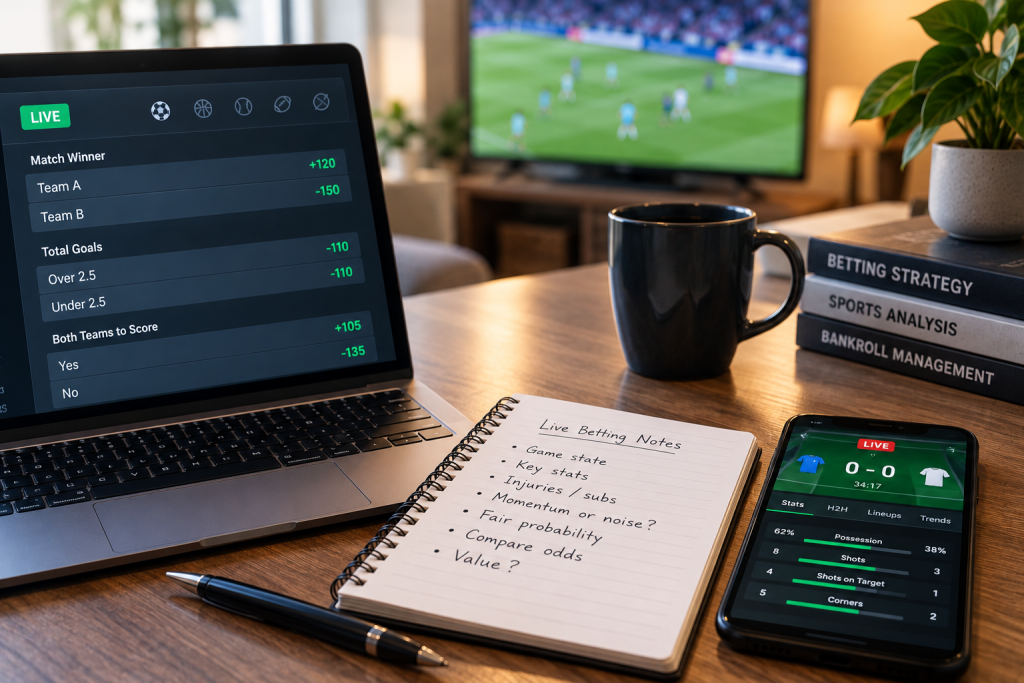
The basic process has four parts: observe the current game state, estimate the probability of an outcome, convert the sportsbook’s odds into implied probability, and compare the two.
The calculation itself is relatively simple. Producing a reliable probability estimate is the difficult part.
Start With a Pre-Game Baseline
Real-time analysis becomes much easier when you already understand the event before it starts.
Suppose an NBA team enters a game as a substantial favorite. If that team falls behind by 10 points early in the first quarter, its live moneyline may move dramatically.
Someone looking only at the score sees a team losing by 10. Someone who studied the matchup sees more context.
How much time remains? Was the deficit caused by unusually hot three-point shooting? Is the favorite generating good shots but missing them? Are its starters still available? Has foul trouble changed the rotation? Has anything happened that should materially change the original assessment of the teams?
The pre-game market provides a useful baseline because it incorporates information available before the event. Live developments should update that baseline rather than completely replace it.
This is essentially Bayesian thinking applied to sports betting. You begin with an initial estimate and update it as meaningful new evidence arrives.
Convert Live Odds Into Implied Probability
Odds are easier to evaluate when translated into probability.
For positive American odds, use:
Implied probability = 100 ÷ (American odds + 100)
For negative American odds:
Implied probability = |American odds| ÷ (|American odds| + 100)
For example, +200 implies a probability of approximately 33.3%.
Odds of -150 imply approximately 60%.
This conversion lets you compare the sportsbook’s price with your own probability estimate on the same scale.
Suppose live odds of +180 imply a probability of about 35.7%. If your model or analysis puts the outcome at 41%, there may be an edge. If your estimate is 34%, the attractive-looking payout doesn’t represent value according to your assessment.
Account for the Sportsbook Margin
Raw implied probabilities contain another complication: the sportsbook margin, often called the vig or overround.
Imagine a two-outcome market where one side is priced at -120 and the other at +100.
The implied probabilities are approximately 54.55% and 50%. Together, they total 104.55%, not 100%.
That additional percentage represents the market margin rather than a literal probability estimate.
A simple way to estimate the market’s no-vig probabilities is to divide each implied probability by the combined implied probability.
For the -120 side:
54.55 ÷ 104.55 ≈ 52.18%
For the +100 side:
50 ÷ 104.55 ≈ 47.82%
Now you have a more useful approximation of the probabilities embedded in the market.
Removing the vig becomes especially useful when you’re comparing your estimate against the market rather than simply deciding whether an individual price looks appealing.
Calculate Expected Value Before Calling Something a Value Bet
A probability advantage can also be expressed through expected value.
Suppose you can bet $100 at +150. A winning wager earns $150 in profit, while a losing wager costs $100.
You estimate the probability of winning at 45%, leaving a 55% probability of losing.
The expected value is:
EV = (0.45 × $150) – (0.55 × $100)
That gives:
EV = $12.50
Based on those assumptions, the wager has an expected profit of $12.50 per $100 risked, or an expected return of 12.5%.
The calculation doesn’t prove your probability estimate is correct. It only tells you what the wager is worth if your estimate is accurate.
That distinction matters. Many apparent value bets are really probability-estimation errors disguised by precise mathematics.
Separate Meaningful Live Information From Noise

One of the hardest parts of identifying value bets in real time is deciding which developments should actually change your probability estimate.
Scores obviously matter, but the scoreboard doesn’t tell the entire story.
Time Remaining Changes the Meaning of the Score
A 10-point deficit with three quarters remaining is fundamentally different from a 10-point deficit with two minutes remaining.
The same applies across sports. A soccer team trailing 1-0 after 20 minutes has far more time to recover than one trailing by the same score in the 85th minute.
Live odds incorporate this relationship between score and remaining opportunity. Your analysis needs to do the same.
Injuries and Personnel Changes Can Alter Fair Value
Some live events change the underlying strength of a team rather than merely changing the score.
If a starting quarterback leaves an NFL game, for example, the impact may extend across moneylines, spreads, totals, team totals, and player markets. A red card in soccer similarly changes the competitive structure of the match.
The key question isn’t simply whether something happened. It’s whether the market has adjusted enough for what happened.
If a sportsbook immediately reprices the relevant markets, there may be no remaining advantage. If your assessment differs materially from the new price, there may be a potential value opportunity.
Short-Term Performance Can Be Misleading
Live betting encourages bettors to overweight whatever just happened.
A basketball team makes four consecutive three-pointers and suddenly appears unstoppable. A tennis player loses a service game and looks vulnerable. An NFL offense produces two ineffective drives and appears incapable of moving the ball.
Some developments contain useful information. Others are normal short-term variance.
The challenge is distinguishing signal from noise. Instead of asking, “Who’s playing better right now?” ask, “What has changed that should alter my estimate of the rest of the event?”
That question makes real-time value analysis much more disciplined.
Watch How Live Odds Move
Odds movement itself provides information.
Suppose you estimate fair odds for an outcome at +140. The sportsbook initially offers +125, which isn’t attractive according to your estimate. A few minutes later, the price moves to +155 even though you haven’t observed anything that materially changes your probability assessment.
The wager has become more interesting because the price changed while your estimate remained roughly stable. This is why experienced value bettors often think in terms of thresholds rather than simply choosing outcomes.
Instead of deciding, “I want to bet Team A,” the decision becomes, “I would consider Team A at +145 or better.” That distinction prevents you from treating every price as interchangeable.
Compare Sportsbooks When Possible
A bet can offer value at one sportsbook and poor value at another.
If the same live outcome is available at +120, +130, and +145 across different books, choosing +145 materially improves the economics of the wager without requiring you to predict anything differently.
The difference becomes substantial over repeated bets.
For example, a $100 winning bet at +120 earns $120 in profit. The same stake at +145 earns $145. That’s a $25 difference from price shopping alone.
Live markets make comparison more difficult because prices change quickly and sportsbooks may suspend markets at different moments. Still, comparing available odds can be one of the most direct ways to improve the price you’re getting.
Readers who want to develop this further can also review a detailed guide to line shopping and comparing sportsbook odds.
Build Fair-Price Thresholds Before the Game
One practical way to reduce emotional decision-making is to decide what prices you want before live action begins.
Consider a tennis match where you believe one player may become undervalued if they lose the first set.
Rather than automatically betting after that happens, estimate beforehand how different match states would affect your probability.
You might determine that you’d only consider the player if the live price reaches +170 or better, assuming there is no injury or significant deterioration in performance.
Now the live decision has structure.
You aren’t chasing a player because the odds suddenly look large. You’re waiting for a predefined price that exceeds your estimate of fair value.
This approach can be extended to moneylines, spreads, totals, and other markets.
Use Live Statistics Carefully
Real-time statistics can improve probability estimates, but only when they have predictive meaning.
In basketball, shooting percentage alone can be deceptive. Shot quality, turnover rate, offensive rebounds, foul situations, pace, and three-point attempt distribution may provide more context.
In soccer, possession percentage can similarly mislead. A team may dominate possession while creating very few dangerous chances. Shot locations, expected goals, red cards, substitutions, and game state can provide a better picture.
For tennis, first-serve percentage, second-serve performance, break-point creation, physical condition, and changes in serve velocity can add useful information beyond the set score.
Statistics should help answer why the event is unfolding as it is. They shouldn’t simply provide more numbers to react to.
Understand the Difference Between Value and Momentum
Momentum is one of the most tempting concepts in live betting because it feels visible.
A team scores twice quickly. A tennis player wins eight consecutive points. A basketball team goes on a 12-0 run.
Sportsbooks are also watching these events. Live pricing systems update continuously, meaning obvious momentum may already be reflected in the new odds.
In some situations, bettors may actually find better prices by looking in the opposite direction when the market reacts strongly to a short-term run that doesn’t materially alter long-term expectations.
That doesn’t mean automatically betting against momentum. It means asking whether recent performance contains enough new information to justify the size of the price movement.
Avoid Confusing Longer Odds With Better Value
A common mistake is assuming that a larger potential payout creates value. It doesn’t.
Suppose an underdog moves from +250 to +400. The new price certainly pays more, but the probability of winning may also have fallen dramatically because of what happened during the event.
At +400, the raw implied probability is 20%. If you believe the team’s actual chance of winning has fallen to 15%, the wager remains unfavorable despite the larger payout.
Price and probability always need to be evaluated together.
The same principle applies to favorites. Short odds aren’t automatically poor value. A -250 favorite could theoretically offer value if its actual winning probability is sufficiently higher than the probability reflected in the price.
Require a Meaningful Edge
Tiny theoretical differences between your estimate and the market should be treated cautiously.
Suppose the market’s no-vig probability is 47% and your estimate is 47.5%. Technically, your estimate is higher, but that half-percentage-point difference may easily fall within your modeling error.
Live markets introduce additional uncertainty because information changes rapidly. Odds can also move between the moment you identify a potential bet and the moment your wager is accepted.
A margin of safety can help account for these problems.
The appropriate threshold depends on how reliable your probability estimates are, the market, and the available price. The broader principle is more important: don’t treat every microscopic discrepancy as evidence that you’ve found a genuine edge.
Track Closing or Subsequent Prices
You don’t have to judge your live betting decisions only by wins and losses.
Suppose you consistently bet outcomes at +150 and the same markets move to +125 shortly afterwards without major new information occurring. That pattern may suggest you’re regularly obtaining favorable prices.
Conversely, if you repeatedly bet +120 and the market quickly moves to +150, your process deserves examination.
This concept is related to closing line value, although live markets make the comparison more complicated because game conditions continuously change.
Record the price you took, the market price shortly afterward, and any major event that occurred between those points. Over time, this creates a much more useful dataset than a simple win-loss record.
A deeper explanation of closing line value can help bettors understand how market prices can be used to evaluate betting decisions over larger samples.
Keep a Real-Time Betting Log
A betting log is especially useful for live wagering because decisions happen so quickly that the original reasoning is easy to forget.
Record the event, market, odds, stake, estimated probability, estimated edge, and the reason you believed the market was mispriced.
For live wagers, add the game state. That could include the score, time remaining, possession, player availability, cards, sets, innings, or other sport-specific information.
Later, review whether your reasoning was actually supported by what happened before the wager. Don’t judge the decision simply by whether it won.
A bet can lose despite having positive expected value. A poorly priced wager can also win. Separating decision quality from individual outcomes is essential for evaluating a value-betting strategy.
Common Mistakes When Looking for Live Value
The speed of live betting creates several recurring errors.
One is reacting to price movement without understanding why it occurred. Odds sometimes move because the sportsbook has information or market activity that you haven’t accounted for.
Another is using stale probability estimates. If a key player is injured, weather conditions change, or the competitive situation shifts materially, your original estimate may no longer apply.
Bettors can also fall into confirmation bias. Once they decide a team is undervalued, they may interpret every subsequent event as evidence supporting that belief.
Finally, repeatedly betting simply because live odds appear attractive turns value betting into price chasing. A large number beside an outcome means very little without an independent estimate of probability.
A Practical Real-Time Value Betting Example
Imagine an NBA team started the game as a moderate favorite but trails 30-20 after the first quarter.
Its live moneyline moves to +160. That price has a raw implied probability of about 38.5%.
You now reassess the game.
The favorite’s key players remain healthy. The opposing team shot an unusually high percentage from three-point range. Turnover numbers are roughly normal, and the pre-game favorite is still creating good shots. Three quarters remain.
After accounting for the deficit and current game state, your model estimates the team’s probability of winning at 44%.
At +160, a $100 winning wager would produce $160 in profit. Using your 44% estimate:
EV = (0.44 × $160) – (0.56 × $100)
EV = $14.40
According to your assumptions, that’s a positive expected value opportunity.
But the reasoning matters more than the result. You didn’t bet simply because the favorite was losing or because +160 looked attractive. You compared the live market’s price with an independently updated probability estimate.
If your estimate had fallen to 35% because the team’s best player was injured, the exact same +160 price would tell a completely different story.
Bankroll Management Still Matters When You Find Value
Identifying value doesn’t eliminate variance.
Even a genuine 60% probability loses 40% of the time. A bettor can therefore make several sound positive-EV decisions and still experience a substantial losing streak. That makes stake sizing part of the process.
Flat staking is one straightforward approach, where each wager represents a small predetermined percentage of the bankroll. More advanced bettors sometimes use methods based on the Kelly Criterion, which connects bet size to estimated edge and odds.
Kelly-based staking is highly sensitive to probability estimates, however. Overestimating your edge can produce stakes that are far too aggressive. Some bettors therefore use fractional Kelly approaches to reduce exposure.
Readers interested in the mathematics behind this can explore a bankroll management and Kelly Criterion guide.
How to Improve Your Ability to Find Live Value
The fastest decisions aren’t necessarily the best ones. Strong real-time analysis comes from doing more work before the event begins.
Develop pre-game probability estimates and identify situations that would cause you to revise them. Determine which statistics matter for the sport and which commonly produce misleading impressions. Establish price thresholds for markets you expect to monitor.
Then review your decisions afterwards.
Over dozens or hundreds of bets, compare your estimated probabilities with actual outcomes and market movements. If outcomes you price around 60% only occur 45% of the time across a meaningful sample, your model may be poorly calibrated.
Calibration matters because expected value calculations are only as useful as the probabilities feeding them.
The objective isn’t to predict every game correctly. It’s to make increasingly accurate estimates and recognize when the available market price differs enough from those estimates to justify taking the risk.
Identifying Value Bets Requires Price Discipline
Learning how to identify value bets in real time changes the question from “Who will win?” to “What probability does this price represent, and is my estimate meaningfully different?” That shift is central to disciplined live betting.
Start with a pre-game baseline, update your probabilities when meaningful information arrives, convert live odds into implied probabilities, account for the sportsbook margin, and calculate expected value when appropriate. Pay attention to price movement, compare available odds, and document why you made each wager.
Most importantly, don’t confuse a winning bet with a good bet or a losing bet with a bad one. Real-time value betting is a probability and pricing problem. The quality of the process becomes visible over repeated decisions, not a single result.