

Understanding risk vs reward in gambling starts with a simple fact: a large potential payout doesn’t automatically make a bet worthwhile.
A wager offering a $1,000 prize may sound more attractive than one paying $50, but the size of the reward tells you nothing about the quality of the wager by itself. You also need to know how much you’re risking, how likely you are to win, what the payout would be if you succeed, and what mathematical advantage the casino or sportsbook has built into the bet.
This distinction matters across casino games, sports betting, slots, lotteries, poker, and other forms of gambling. Risk and reward may look different from one game to another, but the underlying principle remains the same. Every wager exchanges a certain cost for an uncertain outcome.
Learning how that relationship works won’t eliminate gambling risk or create a guaranteed winning strategy. It can, however, help you understand what you’re actually risking instead of judging bets solely by their potential prizes.
Check out the best bonus deals before Midnight tonight!


What Does Risk vs Reward Mean in Gambling?
Risk vs reward describes the relationship between what you stand to lose and what you could receive if a wager succeeds.
The risk side begins with your stake, but it doesn’t necessarily end there. Bet frequency, the probability of losing, the amount of money available in your gambling budget, and the potential for repeated losses all affect your actual exposure.
Reward usually refers to the potential payout or profit. Imagine risking $10 on two different bets. One offers $15 in profit if you win, while another offers $100. The second bet clearly offers the larger reward. That doesn’t mean it’s the better bet.
If the first outcome has a relatively high probability of occurring and the second has an extremely low probability, the relationship between risk and reward changes considerably.
This is why analyzing gambling decisions requires three pieces of information:
- How much you can lose
- How much you can win
- How likely each outcome is
Leaving probability out of the calculation is one of the easiest ways to misinterpret a wager.
Probability Connects Risk and Reward
Probability measures how likely an outcome is to happen. If an event has a probability of 50%, you’d expect it to occur roughly half the time across a sufficiently large number of independent trials. That doesn’t mean every group of two bets will produce exactly one win and one loss.
Short-term results can vary considerably. This distinction between theoretical probability and actual short-term results is essential to understanding gambling.
Suppose a hypothetical game gives you a 25% chance of winning. You could win on your first attempt. You could also lose ten times consecutively. Neither result changes the underlying probability of the next independent play.
For independent events, previous outcomes don’t make the next outcome “due.” The belief that a particular result becomes more likely simply because it hasn’t happened recently is known as the gambler’s fallacy. The Responsible Gambling Council explains that previous results have no effect on future results when events are independent.
That matters because risk shouldn’t be evaluated based on what just happened. It should be evaluated using the probabilities associated with the wager you’re about to make.
Odds Translate Probability Into a Betting Decision
Odds communicate the relationship between the likelihood of an outcome and the amount a winning wager pays.
American sportsbooks generally display odds using positive or negative numbers. Positive odds show how much profit a $100 wager would generate. A bet at +200, for example, returns $200 in profit on a winning $100 stake, plus the original $100 stake.
Negative odds indicate how much you’d generally need to risk to earn $100 in profit. At -200, you’d risk $200 to make $100.
The important point isn’t simply learning to read the numbers. It’s understanding what they imply about probability. For example, +200 corresponds to an implied probability of approximately 33.3% before considering sportsbook margin. That gives you something useful to compare.
If you believe the true probability of the outcome is considerably higher than 33.3%, the price may appear attractive. If your estimate is lower, the large-looking payout doesn’t necessarily compensate for the probability of losing.
This is where understanding how to translate odds formats and implied probability becomes much more useful than simply looking for the highest payout.
Risk-to-Reward Ratio Doesn’t Tell the Whole Story
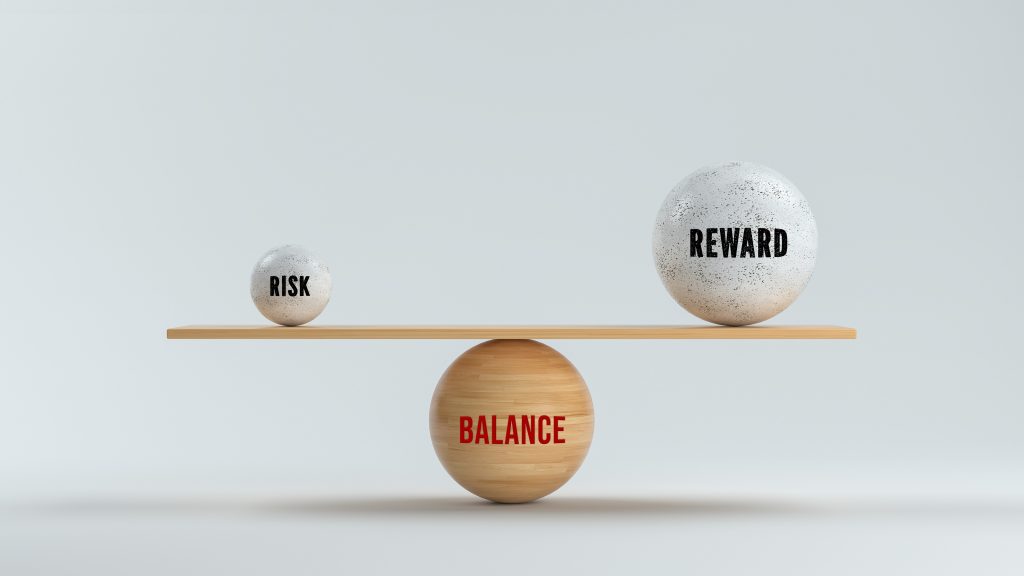
A simple risk-to-reward ratio compares potential loss with potential profit.
Suppose you risk $20 for the chance to make $100 in profit. Your risk-to-reward ratio is 1:5. For every $1 at risk, there are $5 of potential profit. That sounds attractive.
But imagine the wager has only a 5% probability of winning. Now the situation looks very different.
A favorable-looking risk-to-reward ratio doesn’t compensate automatically for an extremely low probability of success. Conversely, risking $100 to win $20 might look unattractive until you discover that the outcome has a very high probability of occurring.
Neither ratio can be interpreted intelligently without probability. This is why gambling risk analysis should move beyond asking, “How much can I win?” A more useful question is, “Is the potential payout reasonable relative to the probability and amount at risk?”
Expected Value Provides a Better Mathematical Framework
Expected value, commonly shortened to EV, combines probability and financial outcomes into one calculation.
The basic idea is: EV = (Probability of Winning × Amount Won) – (Probability of Losing × Amount Lost)
Suppose a hypothetical $10 wager gives you a 40% chance of winning $15 in profit and a 60% chance of losing your $10 stake.
The calculation becomes: EV = (0.40 × $15) – (0.60 × $10)
That equals: $6 – $6 = $0
This hypothetical wager has an expected value of zero.
Now imagine the winning profit drops to $12 while the probabilities remain unchanged.
EV = (0.40 × $12) – (0.60 × $10)
The result is: $4.80 – $6 = -$1.20
The expected value is negative $1.20 per $10 wager. That doesn’t mean you’ll lose exactly $1.20 every time. You might win $12 or lose $10 on an individual attempt.
Expected value describes the theoretical average outcome over repeated wagers under the same conditions.
Understanding how expected value works in betting therefore provides a more meaningful framework for comparing risk and reward than looking at payouts alone.
The House Edge Changes the Risk-Reward Equation
Casino games generally aren’t designed as mathematically neutral propositions between the player and operator. They incorporate a house advantage.
The house edge represents the casino’s theoretical advantage over players across a large volume of wagering. The UK Gambling Commission describes casino games such as roulette and blackjack as games of unequal chance in which the structure gives the house an advantage.
Consider roulette. A payout may appear to correspond closely with the difficulty of predicting the winning outcome, but the payout structure doesn’t fully compensate players for the actual probability involved. That difference creates the casino’s advantage.
This has an important implication for risk versus reward. A bet can offer frequent wins and still carry a house edge. Another can offer rare but enormous prizes while also carrying a house edge.
Changing the payout pattern changes the experience of risk, but it doesn’t necessarily eliminate the underlying mathematical disadvantage.
Over a short session, anything can happen. Over a very large number of wagers, the mathematical structure becomes increasingly significant.
RTP Doesn’t Predict What You’ll Get Back
Return to player, or RTP, is another concept commonly used when discussing slots and other casino games.
An RTP percentage represents a theoretical long-run return across a very large volume of play. If a game has a hypothetical RTP of 96%, that doesn’t mean putting $100 into it guarantees you’ll finish with $96.
You could finish ahead. You could lose your entire gambling budget. You could experience any number of results between those extremes.
The Gambling Commission emphasizes that RTP is an average achieved over a significant number of plays rather than a promise about an individual gambling session. The same distinction applies when comparing two games.
A higher RTP can indicate a smaller theoretical house advantage when other factors are comparable, but it doesn’t tell you how your particular session will unfold.
For risk assessment, you also need to consider how widely short-term outcomes can fluctuate. That’s where volatility enters the picture.
Volatility Determines How Risk Feels in Practice
Two games can have similar theoretical returns while delivering dramatically different experiences. Volatility, sometimes called variance in gambling discussions, describes how much results can fluctuate.
A lower-volatility slot might produce smaller wins relatively frequently. A high-volatility game might produce long stretches with few meaningful returns while occasionally awarding much larger prizes.
Neither pattern tells you what will happen during your next session. But volatility changes the short-term risk profile.
Consider two hypothetical slot games with the same RTP. Game A frequently returns small prizes. Game B concentrates more of its theoretical return into occasional large prizes.
A player using the same bankroll could experience very different results on each game. Game B may create larger bankroll swings because more of its reward is concentrated in less frequent outcomes.
The Gambling Commission specifically notes that actual RTP can vary from theoretical RTP and that volatility affects how widely observed results may fluctuate, particularly over smaller samples of play.
Understanding volatility therefore prevents a common mistake: assuming two games with similar RTP percentages carry identical short-term risk. They don’t necessarily do so.
High Reward Usually Comes With Lower Probability
Gambling products frequently make their largest prizes the most visible. Progressive jackpots, long-shot sports bets, lottery jackpots, and large slot multipliers naturally attract attention because the potential reward is easy to understand.
The probability is less emotionally compelling. Consider a sportsbook market with a heavy favorite and a major underdog. A bettor may see that the favorite offers relatively little profit while the underdog could multiply the stake several times over. Looking only at payouts makes the underdog appear more rewarding.
The missing information is the likelihood of winning. The larger payout exists precisely because the outcome is considered less likely.
The same principle applies to casino jackpots. A life-changing jackpot doesn’t represent free additional value simply because the number is enormous. Its probability has to be considered alongside the payout and amount wagered.
Large rewards and good value aren’t synonyms.
Bet Size Changes Financial Risk Without Changing the Odds
One of the most important distinctions in gambling is the difference between the riskiness of a wager and the riskiness of how you choose to bet it.
Suppose a sportsbook offers the same wager to two people. One risks $10. The other risks $1,000. The odds are identical. The underlying probability is identical. The mathematical quality of the wager is identical.
Their financial exposure isn’t. This is why bankroll management matters even when someone understands odds and probability correctly. You can make a mathematically informed betting decision and still risk an unreasonable percentage of the money available to you.
Increasing stake size doesn’t make an outcome more likely. It simply magnifies the financial consequences of the same uncertain outcome.
A particularly dangerous version of this behavior occurs when bettors increase their wagers after losing in an attempt to recover previous losses.
Chasing Losses Distorts Risk vs Reward
Imagine losing $50 and deciding that the next wager needs to win that money back. The next betting decision is no longer being evaluated independently. Instead, its perceived reward now includes an emotional objective: erasing the previous loss. That can encourage larger wagers or bets someone wouldn’t normally consider.
If the second wager also loses, the perceived amount that needs to be recovered becomes even larger. The cycle can continue while financial exposure increases. Nothing about the underlying probabilities improves simply because you’re losing.
The National Council on Problem Gambling specifically advises against chasing losses and recommends setting financial and time limits before gambling. It also recommends gambling only with money that isn’t needed for necessities such as bills, rent, or savings.
Understanding why chasing losses damages a bankroll is therefore part of understanding risk itself. Past losses are already incurred. Increasing future risk doesn’t reverse them.
Winning Streaks Can Distort Risk Perception Too
Losses aren’t the only outcomes that affect judgment. Winning can create its own risk.
After several successful wagers, a player may begin to feel unusually confident. Bets that previously seemed too large may suddenly appear reasonable because the person feels they’re playing with “house money.” But winnings are real money once they’re yours.
If you started with $100, won another $200, and then risk the full $300, you’re risking $300. The fact that some of it came from previous winnings doesn’t make the loss less real.
Winning streaks can also encourage people to interpret short-term success as evidence of predictive skill. Some forms of gambling involve meaningful skill, particularly poker and certain sports-betting decisions. Even there, short-term outcomes contain substantial uncertainty.
A winning streak alone doesn’t prove that someone has found a sustainable advantage. Separating results from decision quality is one of the most useful habits a gambler can develop.
A Good Decision Can Lose and a Bad Decision Can Win
This distinction is fundamental to gambling. Suppose you make a wager based on sound probability analysis and receive a fair or favorable price. The outcome loses. Was the decision necessarily bad? No.
Now suppose you make a poorly researched long-shot bet with an unfavorable price and it happens to win. Was the decision necessarily good? Again, no. Individual results don’t tell you everything about the quality of the original decision.
Gambling contains randomness, which means good decisions can produce losses and poor decisions can occasionally produce spectacular wins.
Evaluating decisions solely by outcomes creates a dangerous feedback loop. A lucky win can reinforce reckless behavior, while an unlucky loss can cause someone to abandon a disciplined approach.
Risk management works better when decisions are evaluated using the information available before the outcome occurred.
Risk Differs Across Types of Gambling
Risk and reward don’t appear in exactly the same form across every gambling activity.
Casino Table Games
In games such as roulette, baccarat, and blackjack, the rules and payout tables determine the mathematical relationship between risk and reward.
Different wagers within the same game can have different probabilities, payouts, and house edges. Understanding the rules therefore matters before comparing bets.
Slots
Slots combine RTP with volatility, paylines or ways-to-win mechanics, bonus features, and highly variable prize structures.
Two slots can advertise similar RTP figures while producing very different short-term experiences. Jackpot-heavy or high-volatility games may concentrate more potential reward in relatively uncommon outcomes, creating larger swings.
Sports Betting
Sports betting adds another layer because bettors evaluate uncertain real-world events rather than outcomes generated entirely by a casino game.
The sportsbook converts its assessment of probability into odds and builds a margin into the market. A bettor’s task isn’t simply predicting who will win. Price matters too. A team can be highly likely to win while still being unattractive at the available odds.
Poker
Poker differs from many casino games because players compete primarily against each other while the operator generally earns money through rake or tournament fees. Skill, opponent behavior, position, probabilities, and strategy all influence decisions.
Variance still matters, however. A strong poker player can make a mathematically correct decision and lose the hand.
Lotteries and Jackpots
Lotteries emphasize extreme reward relative to a small individual stake. The amount at risk on one ticket may be low, but the probability of winning the top prize can also be extremely small. This is a classic example of why reward size shouldn’t be evaluated without probability.
Time Is Part of Gambling Risk
Risk isn’t determined only by the size of individual wagers. How often you gamble matters too.
Suppose someone makes a single $5 wager. Compare that with someone repeatedly making $5 wagers over several hours. The amount risked on each individual decision hasn’t changed, but total wagering volume can become dramatically larger.
This is especially relevant in fast-paced gambling products where many decisions can occur in a short period. A small stake can feel harmless when viewed in isolation. Repeated hundreds of times, it represents substantial cumulative wagering.
The National Council on Problem Gambling recommends setting both financial and time limits, recognizing that prolonged play can increase exposure even when individual stakes remain relatively small.
A realistic assessment of risk therefore considers session length and betting frequency alongside stake size.
Why Short-Term Results Can Be Misleading
Human beings naturally look for patterns. Gambling creates an environment where patterns appear constantly.
A roulette wheel lands on black five times. A slot hasn’t triggered its bonus for an hour. A basketball favorite has covered the spread six games in a row. These sequences can feel informative even when they provide little or no useful information about the next independent outcome.
Randomness doesn’t mean results alternate neatly. Random sequences naturally contain streaks, clusters, and surprising runs. The Gambling Commission explains that on random gaming machines, the odds of winning the current game remain constant and aren’t affected by previous wins or losses.
That’s why phrases such as “it’s due” should immediately raise questions. If the underlying events are independent, recent results don’t create a debt that probability needs to repay.
How to Evaluate Risk Before Placing a Bet
A useful risk assessment starts before money is committed.
First, understand the wager itself. Know the stake, payout, relevant odds or probabilities, and conditions required to win. Then separate potential payout from value.
A large prize may be exciting, but ask what probability justifies that payout. In sports betting, that means comparing the price with your estimate of the outcome’s true probability. In casino gambling, it means understanding the house edge, RTP, and volatility where that information is applicable.
Next, consider the wager in relation to your personal gambling budget. A $100 bet doesn’t have the same financial significance to every person. Money needed for housing, food, debt payments, emergency savings, or other financial responsibilities shouldn’t become gambling capital.
Finally, decide what you’re willing to lose before the outcome creates emotional pressure. Predetermined limits are more useful than limits invented after a losing streak has already started.
Risk Management Doesn’t Turn Gambling Into an Investment
Terms such as bankroll management, expected value, probability, and risk-to-reward ratio can make gambling sound similar to investing. The comparison has limits.
Many casino games are explicitly structured with a mathematical advantage for the operator. Even in forms of gambling where skill or analysis can affect decisions, uncertainty remains substantial.
Responsible gambling organizations recommend treating gambling as entertainment rather than as a way to generate income. That distinction affects how risk should be viewed.
An entertainment budget has a maximum amount you’re prepared to spend for the experience. It shouldn’t depend on winning the money back later. If losing the gambling budget would create a financial problem, the amount at risk is already too high regardless of how attractive the potential reward appears.
Knowing When Risk Is No Longer Worth the Reward
The mathematical side of gambling risk is only part of the picture. Personal consequences matter too. A bet can be affordable on paper but still become problematic if gambling begins taking more time, attention, or emotional energy than intended.
Warning signs can include thinking constantly about gambling, feeling the need to bet larger amounts more frequently, repeatedly trying to recover losses, and continuing despite harmful consequences. The National Council on Problem Gambling identifies these behaviors among signs associated with problem gambling.
At that point, the issue isn’t finding better odds or improving bankroll management. It’s reducing or stopping gambling and seeking support when needed. In the United States, the National Problem Gambling Helpline can be reached by calling or texting 1-800-MY-RESET.
Understanding Risk vs Reward Leads to Better Gambling Decisions
Understanding risk vs reward in gambling means looking past the size of a potential prize.
Every wager has several dimensions: the amount at risk, potential return, probability of winning, house or sportsbook advantage, volatility, bet frequency, and financial consequences of losing.
A large payout may accompany a very low probability. A frequent-win game may still have a house edge. A high-RTP slot can still produce a severe short-term loss. A sensible wager can lose, while a poor decision can occasionally win.
None of those contradictions disappear once you understand the mathematics. What changes is your ability to interpret them.
The most useful approach is to evaluate the wager before the result, keep stake size separate from emotion, understand the odds and house advantage, and treat losses as a possible cost of entertainment rather than money that must be recovered.
Risk can never be removed from gambling. If there were no uncertainty and no possibility of loss, it wouldn’t be gambling. Understanding risk vs reward simply makes that uncertainty clearer, allowing you to decide whether the potential reward is worth the financial risk before you place the bet.


